| Configuration | Vertices | Edges | Faces | Cells | Result | |||
| {5, 3, 3} | 600 | 7200 | {}@3 | 7200 4800 |
{3} | 4800 1200 |
{3, 3} | 2 * 5 * {3, 3, 5} |
| 1200 | {3, 5} | 2 * 5 * {3, 5, 5/2} | ||||||
| 7200 | {}@19 | 7200 4800 |
{3} | 4800 1200 |
{3, 3} | 2 * 5 * {3, 3, 5/2} | ||
| 1200 | {3, 5/2} | 2 * 5 * {3, 5/2, 5} | ||||||
These two sections are very similar, so they will be described together. Although there is no intransitivity in the edges, there is in the triangles, they come in two types, say A and B. From these tetrahedrons are formed and (in section 3) icosahedrons or (section 19) great icosahedrons. The symmetry group is transitive on the latter two. And also the final results are transitive. The tetrahedrons come also in two kinds. The first kind has three A-type faces and one B-type face, the other kind has four B-type faces. Each face is used two times in the set of tetrahedrons. Each A-type face in two tetrahedrons of the first kined, each B-type face in one tetrahedron of each kind. How they figure in the 600-cell and the star form is still to be determined.
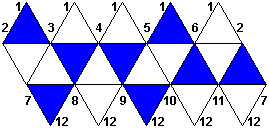
The distribution in the icosahedron (and in the great icosahedron) are a bit strange, I will only cover the first, the second is analogous. Each icosahedron has twelve A-type faces and eight B-type faces, distributed as follows:
where a white face is a face of type A and a blue face is of type B. For the set of icosahedrons, each A-type face is used three times and each B-type face eight times. Note that the A-type faces form connected pairs while the B-type faces are disconnected.
| Configuration | Vertices | Edges | Faces | Cells | Result | |||
| {5, 3, 3} | 600 | 2400 7200 |
{}@8 | 2400 14400 4800 |
{3} | 4800 1200 |
{3, 3} | part connected |
| 600 4800 |
{3, 4} | [225] * {3, 4, 3} | ||||||
| 1200 | {3, 5} | part connected | ||||||
| 1200 | {3, 5/2} | part connected | ||||||
| 1800 14400 |
{4} | 600 4800 |
{4, 3} | [225] * 3 * {4, 3, 3} | ||||
| 400 1200 |
{6} | disconnected | ||||||
| 7200 | {5} | 1200 | {5, 5/2} | 2 * 5 * {5, 5/2, 3} | ||||
| 7200 | {5/2} | 1200 | {5/2, 5} | 2 * 5 * {5/2, 5, 3} | ||||
This section is already a bit more complicated. Because in this case not all edges cover the same graph distance, there is intrinsic intransitivity in the edges. The come in two kinds, say 2400 A and 7200 B.
When triangles are formed we get even three kinds of triangles, 2400 of type A with all edges of type A, 4800 of type B with all edges of type B and 14400 of type AB with one edge of type A and two edges of type B. The set of triangles covers each A-type edge nine times and each B-type edge six times.
The three kinds of triangles result in two kinds of tetrahedrons. One kind (AB) has one face type A and two faces type AB (and there are 4800 such tetrahedrons). The other kind (B of which there are 1200) has all faces of type B. Each face type A is used twice, the other faces only once.
When we form octahedrons from the triangles we also get two kinds: 600 type A with all faces of type A and 4800 type AB with six faces of type AB and two faces of type B according to the following pattern:
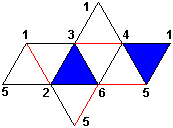
where the B-type faces are blue (note that they are opposite faces). The A-type edges are given in red, there are three such in each of these octahedrons. Each face is used twice. When forming 24-cells the two kinds of octahedrons do not mix, so there are also there two kinds.
Next, when we form icosahedrons (and great icosahedrons) all three kinds of faces are used, each has four A-type faces, four B-type faces and twelve AB-type faces according to the following pattern:
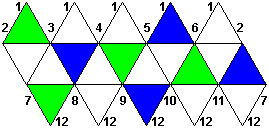
where A-type faces are green and B-type faces are blue. Each A-type face is used twice, the other faces only once.
When we form squares from the edges we also get two kinds, the 1800 of type A have only A-type edges, the 14400 of type AB have one A-type edge and three B-type edges. So each A-type edge is covered nine times and each B-type edge is covered six times. When we get to higher dimensions the kinds do not mix. However, it is interesting to see the distribution of A-type edges in a cube of type AB:
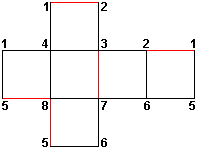
the A-type edges are given in red. The picture below shows how the edges are distributed in the tesseract:
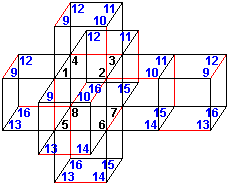
You probably need some squinting to understand it, but the edges of kind A are given in red (and many occur multiple times). There are eight A-type edges and 24 B-type edges. When you look close you will see that all cubes have the same 3D handedness, so it appears that there are tesseracts of two kinds. But we should already have known that from the parent page.
Next, when the 7200 pentagons and pentagrams are formed, each has two A-type edges and three B-type edges according to the following circular pattern: BABAB. So each A edge is covered six times and each B edge three times. When the pentagons form great dodecahedrons and the pentagrams form small stellated dodecahedrons the in the result each object has twelve A-type edges and eighteen B-type edges according to the following pattern:
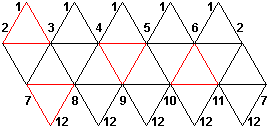
Here the A-type edges are given in red. (Note that this picture corresponds to the picture above.) To see the faces (e.g. pentagons) from this picture, follow either the straight horzontal lines or the hexagons (that all have one edge missing). Note that two of the hexagons are in part at the left-hand side of the picture and in part on the right-hand side, so also 1-6-11-7-3-1 is one such hexagon.
Finally, the hexagons all have edges of only on kind.
| Configuration | Vertices | Edges | Faces | Cells | Result | |||
| {5, 3, 3} | 600 | 1800 14400 |
{}@15 | 2400 14400 4800 |
{3} | 600 600 4800 4800 |
{3, 3} | [225] * 3 * {3, 3, 4} |
| 300 2400 |
{3, 4} | disconnected | ||||||
| 450 3600 |
{4} | disconnected | ||||||
Although there is no immediate geometric reason that forces the edges to split in two kinds, there is a group-theoretical reason. The number of edges is larger than the number of elements in the symmetry group, so that group can not be transitive on the edges. There are actually two kinds, 1800 of kind A and 14400 of kind B. Also in higher dimensions the two do not mix, but there is more going on for each kind.
When we form tetrahedrons each one has three faces of type B1 and one face of type B2, but also this set splits in two groups. Again, how this works out later is still to be investigated.
The octahedrons all have six faces of type B1 and two of type B2 according to the following pattern:
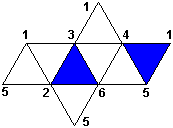
where the faces of type B2 are in blue (and also here these are opposite faces).
| Configuration | Vertices | Edges | Faces | Result | ||
| {5, 3, 3} | 600 | 2400 | {}@22 | 400 * 2 400 |
{3} {6/2} |
disconnected |
| 7200 | 1200 * 2 1200 |
disconnected | ||||
Intransitivity in this section is because there are different graph distances. Moreover, the different kinds of edges do not mix.