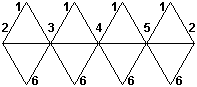
V1/ V2, V3, V4, V5/ V6
corresponds to the following picture:
although more commonly the following {equivalent} figure:
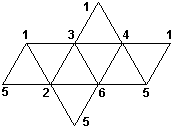
is used.
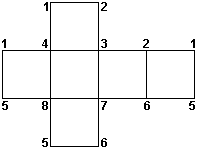
V1, V2, V3, V4/ V5, V6, V7, V8
corresponds to the following picture:
V01/ V02, V03, V04, V05, V06/ V07, V08, V09, V10, V11/ V12
corresponds to:
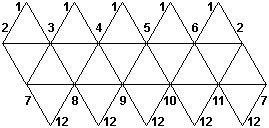
This same notation is also used for the star polyhedrons in the icosahedron, so for the great dodecahedron the tables actually use exactly the same entries, but now the faces are pentagons, like
V02, V03, V04, V05, V06
(the edges of the icosahedron and the great dodecahedron
are the same, it is only what you see as faces where they do differ).
For the other two it is about the same, but you have to keep in mind that in that case the Euclidean distance between V01 and V02 is larger than that between V01 and V07. However, the faces can be found in the same way, leading to either triangles or pentagrams.
    V01, V02, V03, V04, V05/ V06, V07, V08, V09, V10\
    V11, V12, V13, V14, V15/ V16, V17, V18, V19, V20
correspond to the following picture:
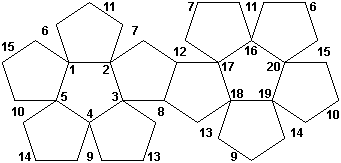
Also here the great stellated dodecahedron shares the same description, but now the faces are pentagrams, and distances are distorted in the description.
V01//V02/ V03, V04, V06, V05/ V07//V08
where the part between the double slashes give a central octahedron and
the first and last vertices are the vertices added in 4D. Note that
vertices 5 and 6 are interchanged above so that the pictures will be
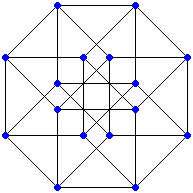
clearer. The clearest graphic picture is given by the following network:
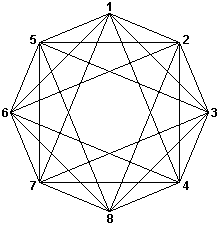
but be aware that all edges have equal length.
    V01, V02, V03, V04/ V05, V06, V07, V08//\
    V09, V10, V11, V12/ V13, V14, V15, V16
just give two opposite cubes of the tesseract, where V01 is connected to
V09, etc.. For this one there is a 3D picture:
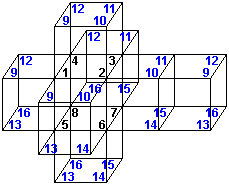
This is a 3D fold-out of the tesseract. The vertices marked in black form a cube with the face 1-2-3-4 on top and the face 1-2-6-5 in front. The remainder is marked in blue (note that all blue vertex numbers occur multiple times, in 4D those multiple occurrences should be joined). As a network, the following picture can serve: