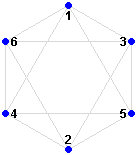
At this moment network pictures of only a few polytopes are given in a network. Here I describe those pictures and how to find the cells in different sections.
Section 1 has the following edges:
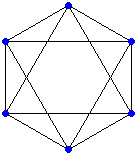
The three disconnected squares can be seen in the following picture:
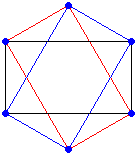
the three squares are given in red, blue and black.
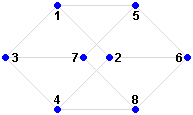
Note that the images have been elongated in the horizontal direction to avoid vertices that go to the same image.
Section 1 has the following edges:
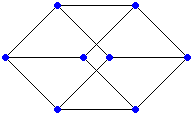
Section 2 has the following edges (two of them are a bit distorted):
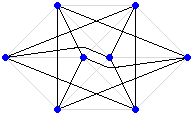
The two tetrahedrons can be seen in the following:
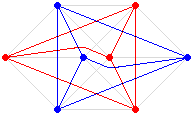
they are given in red and blue. Note that they are completely disconnected.
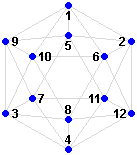
Section 1 has the following edges:
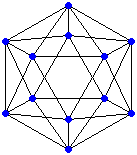
The pentagons can be found according to the following pictures:
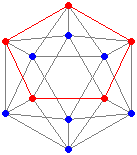
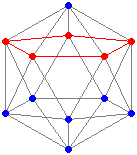
Each picture you can rotate giving a total of twelve pentagons.
Section 2 has the following edges:
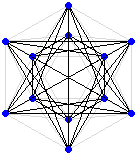
The middle vertical edge is not a single edge, but is actually two edges, one joining the top vertex with the third vertex from the top, the other joining the other two. It is similar with the two other long edges we get by rotation.
To show the triangles we need three pictures:
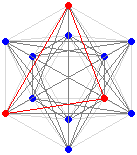
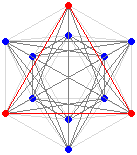
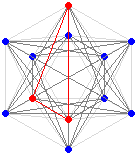
The first picture gives six triangles when we rotate, the second only two and the third gives twelve triangles when we rotate and flip, for a total of twenty triangles.
The pentagrams need two pictures:
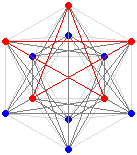
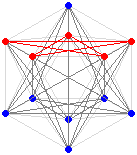
For both, with rotation, we get six pentagrams for a total of twelve.
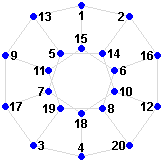
Section 1 has the following edges:
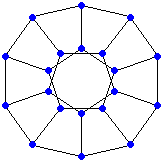
The pentagons are found according to the following two pictures:
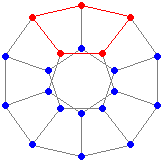
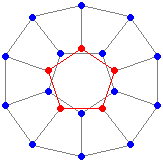
The first one gives (with rotations) ten pentagons, the second one only two, for a total of twelve.
Section 2 has the following edges (some slightly distorted):
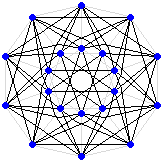
The pentagrams are found with:
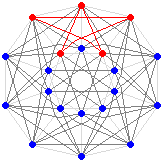
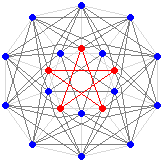
Again, the first picture gives ten and the second two.
For the pentagon we use:
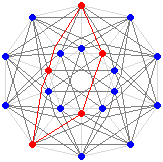
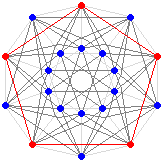
And also here ten for the first and two for the second picture.
For the cubes a single picture is required:
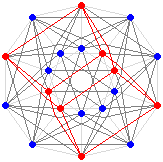
Rotation gives you only five cubes (because of the symmetry).
Section 3 has the following edges (some slightly distorted):
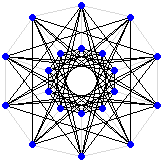
It becomes quite busy in the centre of the picture. The tetrahedra can be found through the following picture:
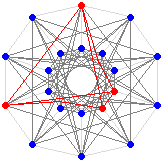
You can rotate the picture along 36 degrees to get all ten tetrahedra. However, when you rotate the picture by multiples of 72 degrees you get only five of them, and they form a compound (each vertex is covered once). So the other five give also a compound. When you look at the picture and mirror it along one of the long axes of symmetry you will find that the picture is rotated an odd multiple of 36 degrees, so it comes in the other group. This indicates the left- and right-handedness of the compounds.
Section 3 has the following edges (some slightly distorted):
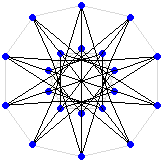
The long lines through the centre are actually two edges, joining alternating vertices on the line.
The pentagrams can be found here:
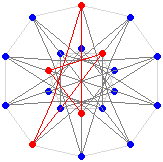
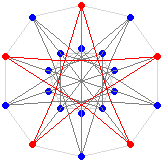
And again, through rotation the first gives ten pentagrams and the second two, for a total of twelve. Here edges are common between two different pentagrams, and indeed, this forms the last star polytope in 3D.
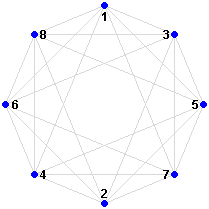
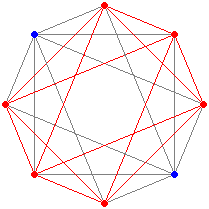
Section 1 has the following edges:
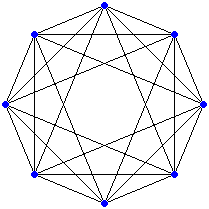
How to find the cells (tetrahedra) is shown here:
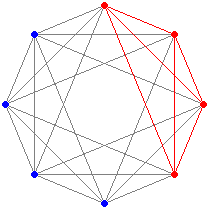
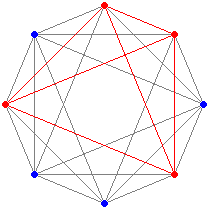
By rotation you will see that each picture gives gives eight cells. You get from the left-hand picture to the right-hand picture when you interchange the (opposite) vertices on the middle row. In a similar way you may always interchange opposite vertices, and this way you get the symmetry group of the object.
Here you see a way to find an octahedron:
When you omit two opposite vertices (with their edges) you get octahedra. When you omit two pairs of opposite vertices, you get squares. So it is extremely simple.
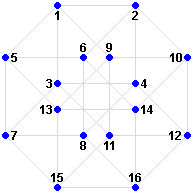
Section 1 has the following edges:
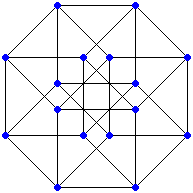
This picture shows one of the cells:
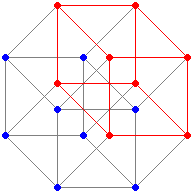
By rotation you get the other seven cells.
Section 2 looks as follows (some of the edges have been distorted, so it does look as if there is only rotational symmetry; that is false, there is also mirroring possible):
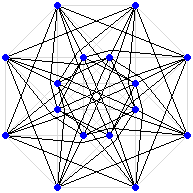
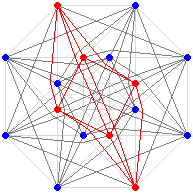
This picture shows how it consists of two 16-cells:
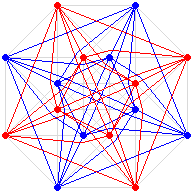
Note that the blue 16-cell has no connection at all with the red one. That is the reason I name this totally disconnected.
Finding the cells (tetrahedra) is simplified by the following pictures:
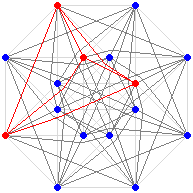
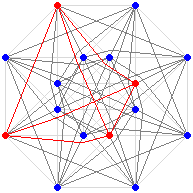
Rotating the pictures through multiples of 90 degrees you get the eight cells (two times four) that make up the red 16-cell above. With rotations with other multiples of 45 degrees you get the cells that make up the blue 16-cell. Although the symmetry group is transitive on all eight cells you can derive from each of the pictures, it does discriminita between cells derived from different pictures. The are inherently different.
The octahedra you can find are easy, nevertheless two pictures:
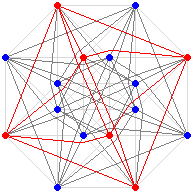
By rotation you get the other octahedra. In this case the symmetry group does not discriminate.
This shows section 3:
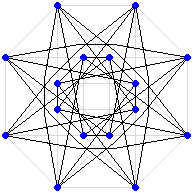
It is entirely without additional features.
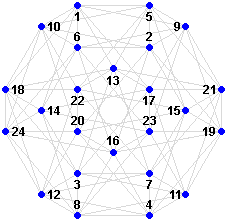
Section 1 has the following edges:
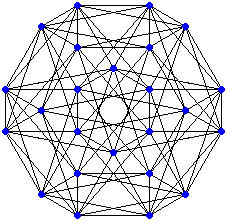
These pictures show how to find the cells:
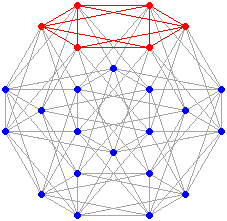
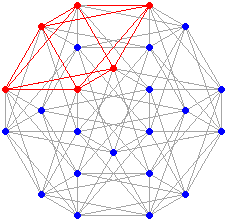
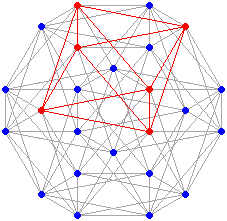
The first two can be flipped horizontally and vertically, and can be rotated 120 degrees. This gives five more for each. The same can be done for the third, but this gives eleven more, for a total of 24 cells.
The following picture shows how to find the tesseracts:
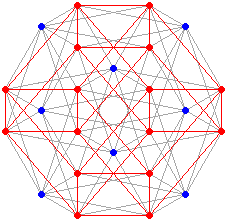
The other two can be found by rotating the picture 120 degrees, either clockwise or counterclockwise.
The cubes that work as cells are shown here:
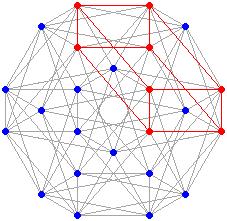
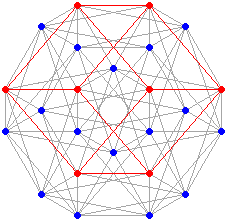
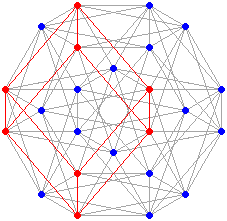
The first gives four when you flip horizontally and/or vertically, the second gives a new one only when you flip vertically and the last one only when you flip horizontally.
The hexagons are found through the folowing pictures:
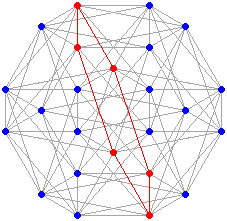
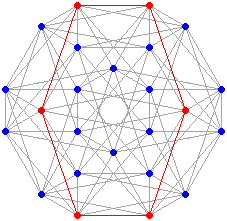
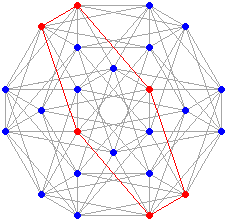
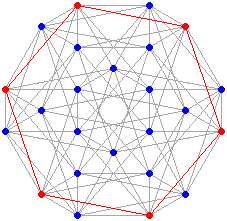
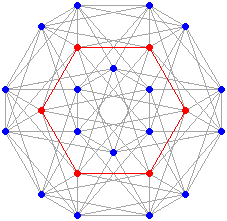
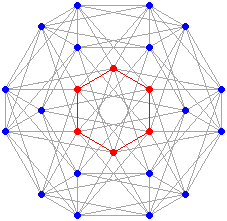
The first gives six with rotation and flipping, the second and third three (rotation only), the fourth two (also rotation only) and the last two only one.
Section 2 has the following edges (deformed):
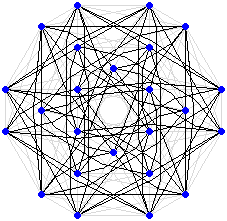
(The deformation is because otherwise there would be too much overlap of edges, consider one of the vertically aligned set of six vertices, which contains triangles.)
The three 16-cells are shown here:
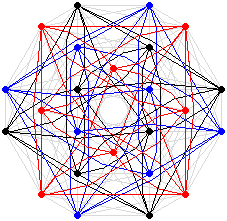
One of them is in red, the second in blue and the third in black. Note that you can get from one to another by rotation. Also note that there are no edges connecting vertices of different colour, so this is a total split.
The cells (tetrahedra) can be found as follows (only those in the red 16-cell are shown, the others you obtain by rotation):
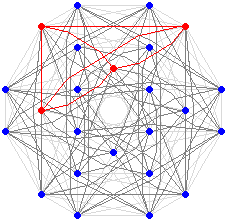
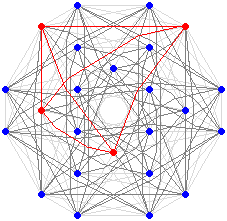
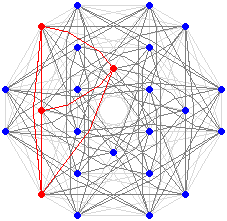
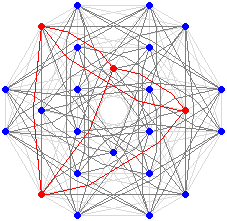
All four give four tetrahedra when you flip horizontally or vertically.
The following pictures give the octahedra:
The first gives two with flipping, the other two pictures only one.
Section 3 has the following edges:
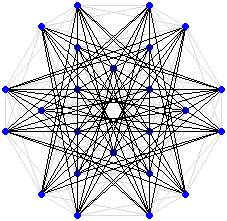
Although there is overlap of edges, there is no deformation (it would make the picture still less clear). Moreover, there can not be confusion in this case.
Like the hexagons in section 1, the hexagrams require six pictures:
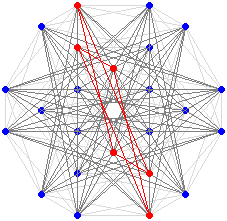
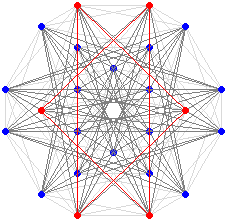
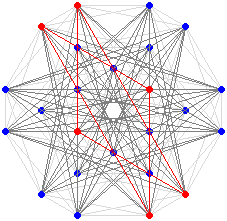
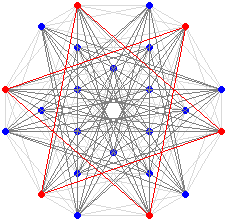
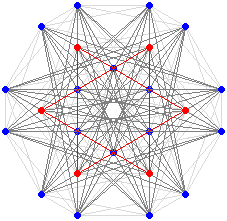
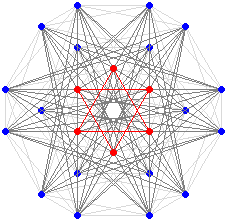
And as with the hexaxons, the first picture gives six hexagrams with rotation and flipping, the second and third three (rotation only), the fourth two (also rotation only) and the last two only one.
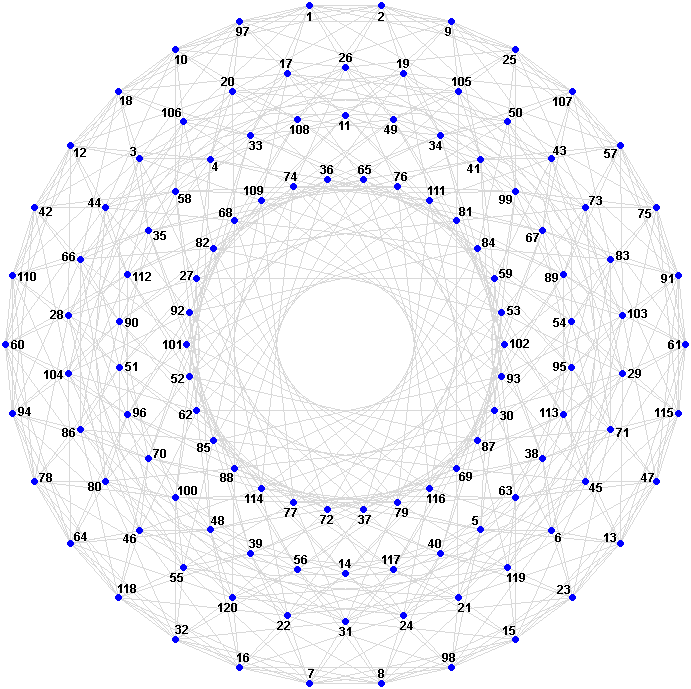
Section 1 has the following edges:
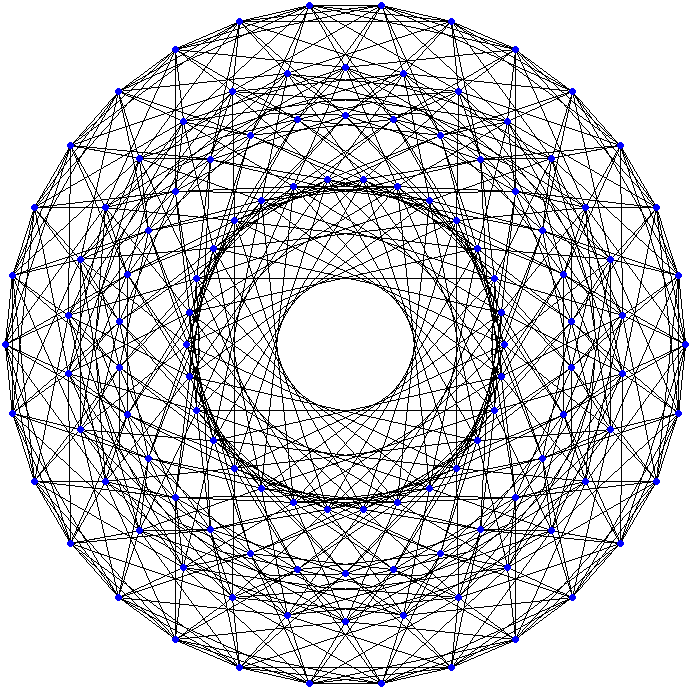
The picture is based on the drawing by van Os in Coxeter's book, but the inner circle of vertices is moved a bit to the outside to get more place. Also a few edges are bent.
The following pictures show the 5-cells that can be found:
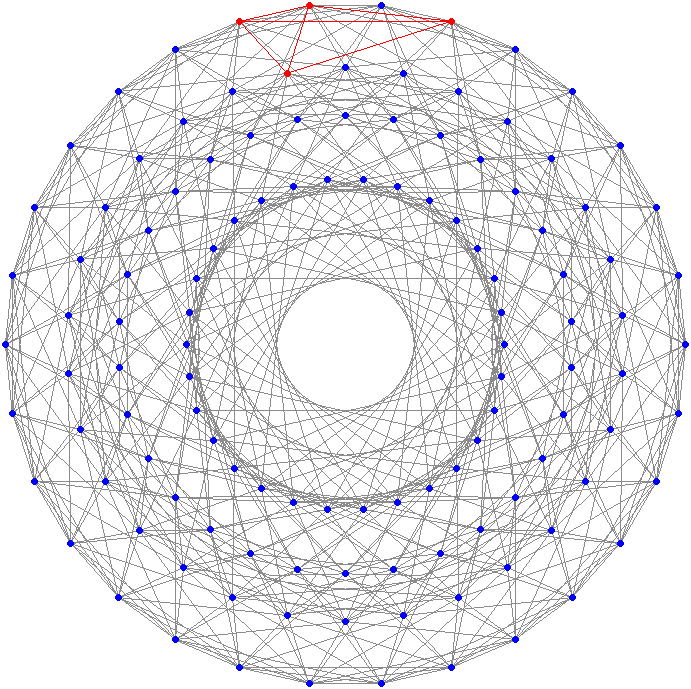
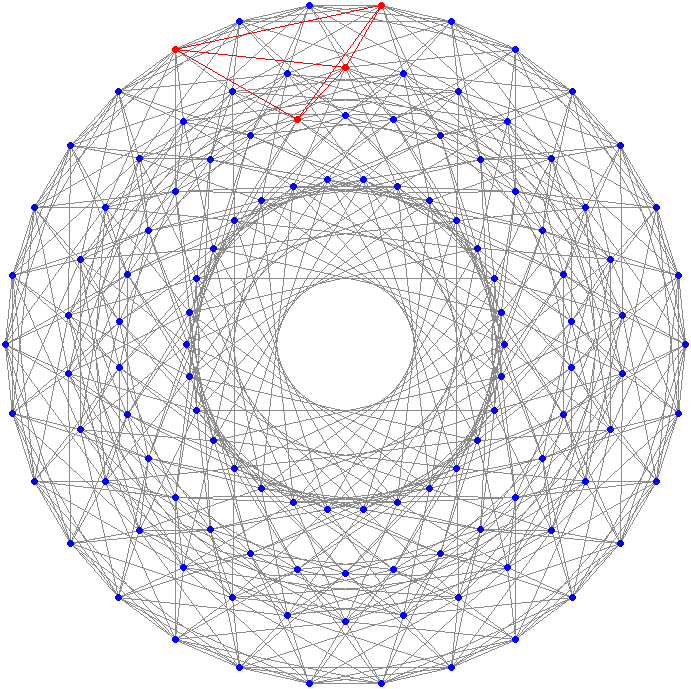
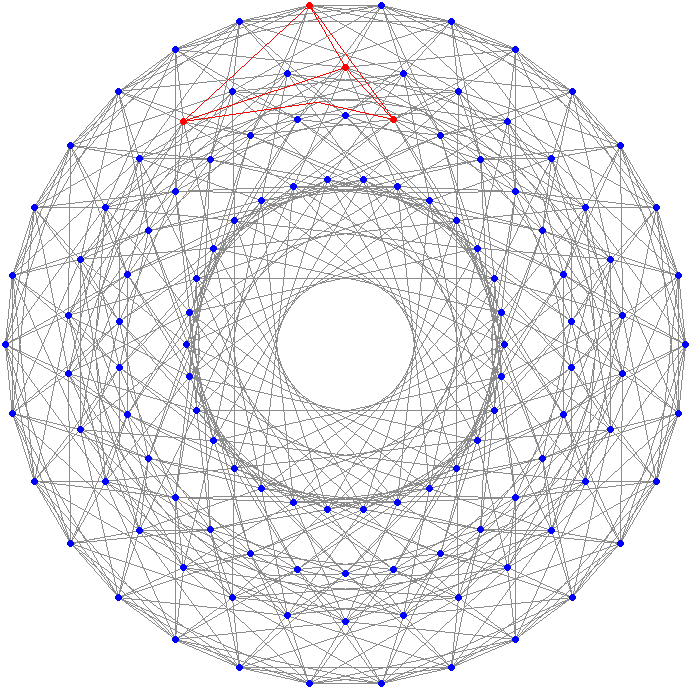
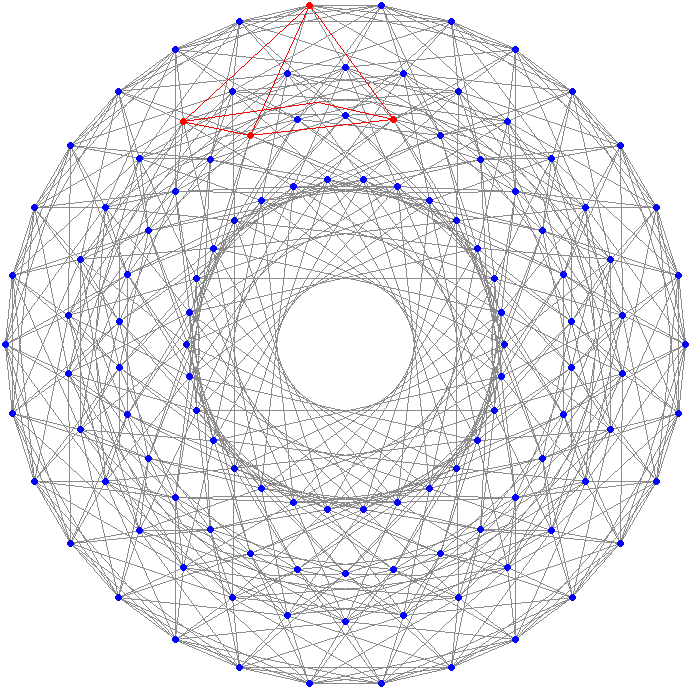
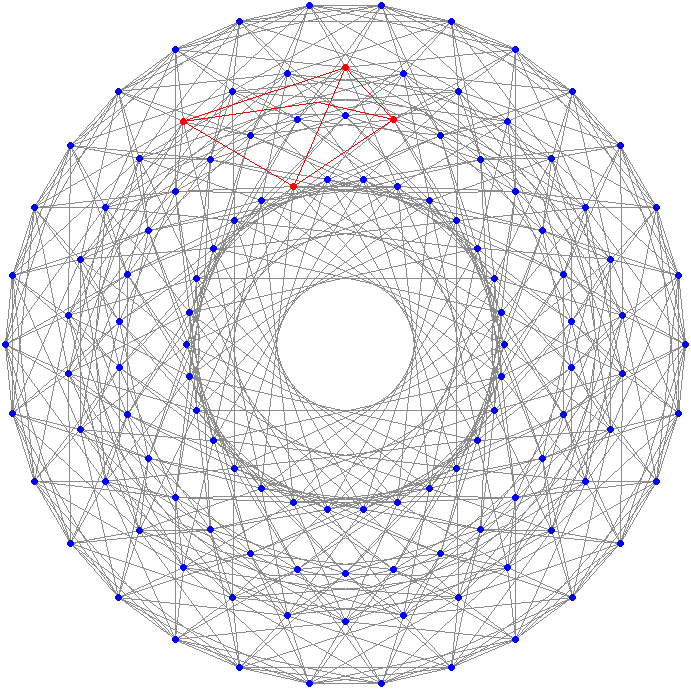
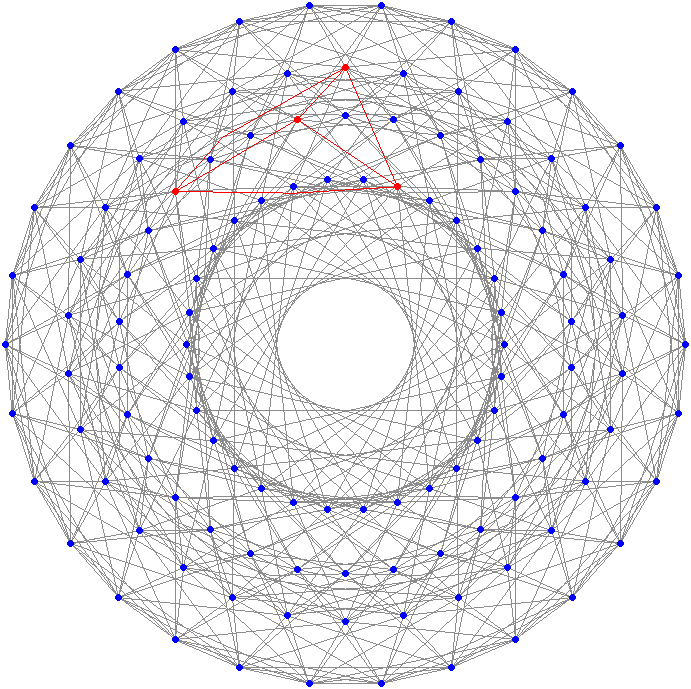
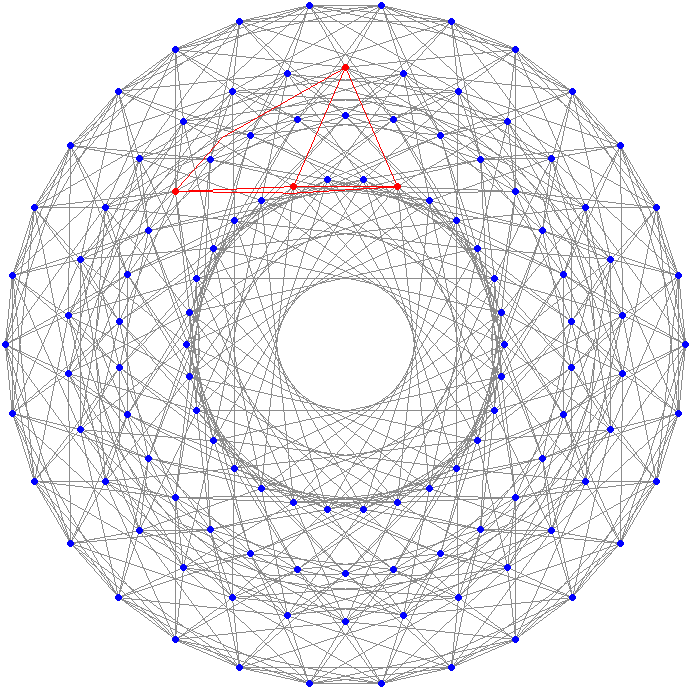
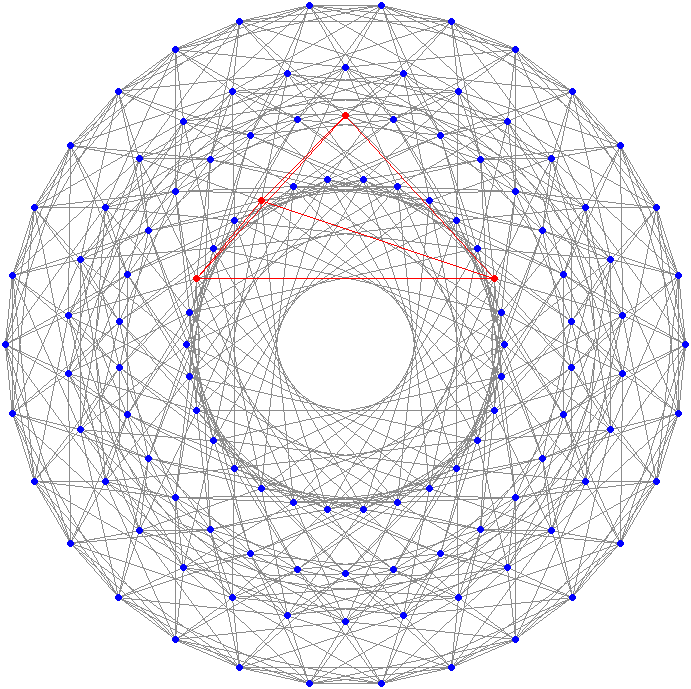
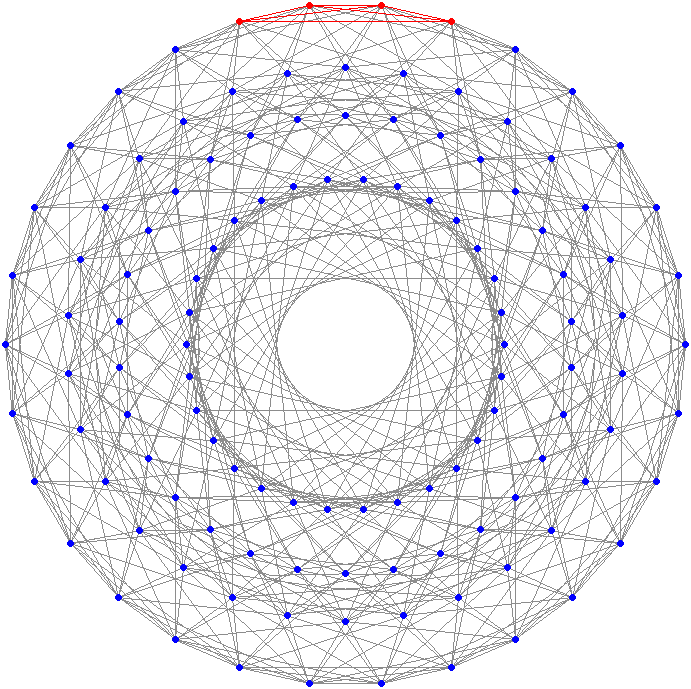
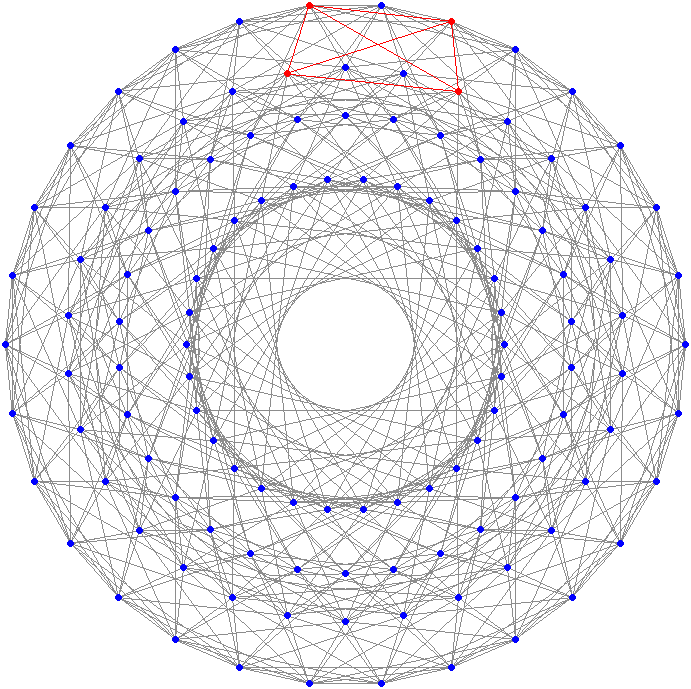
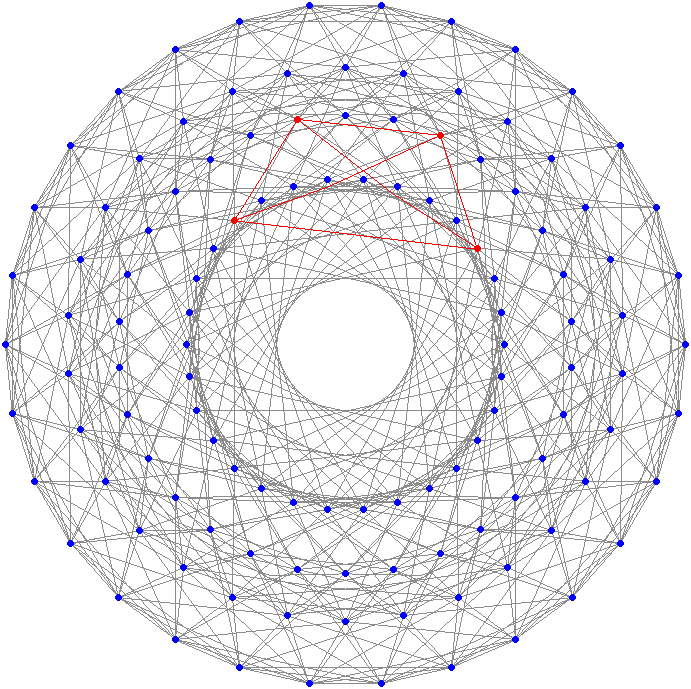
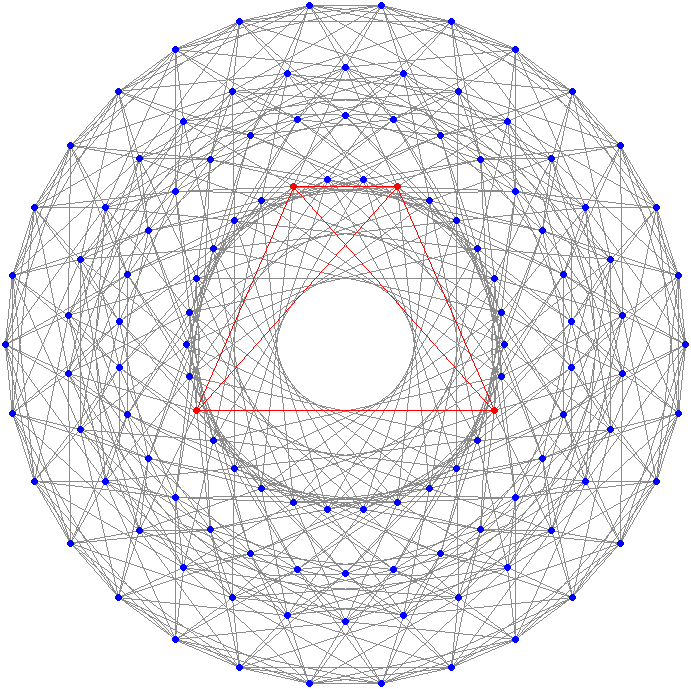
The first eight give each sixty with rotations and flipping, the last four give only thirty that way.
Here are the icosahedra that make the icosahedral 120-cell:
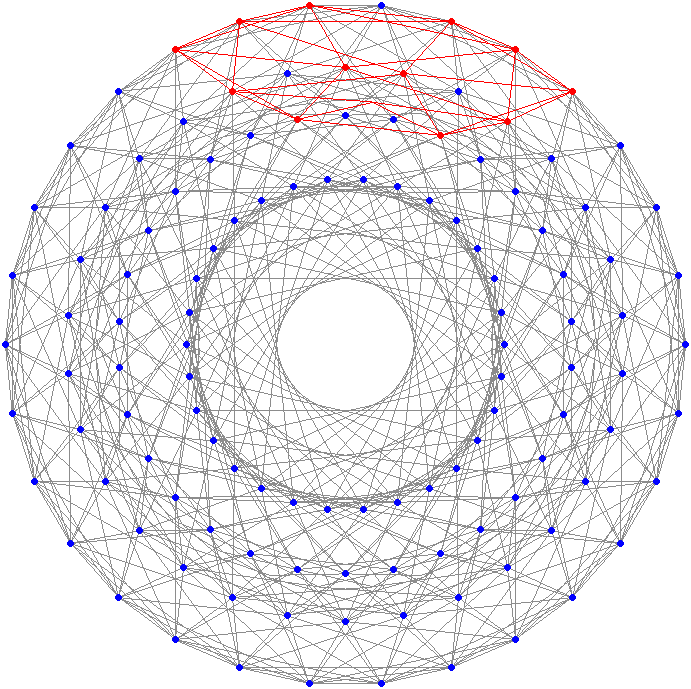
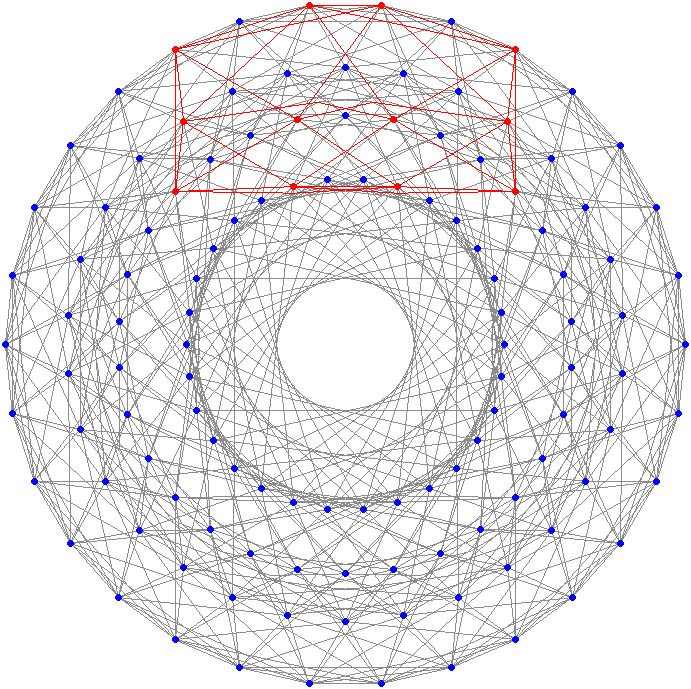
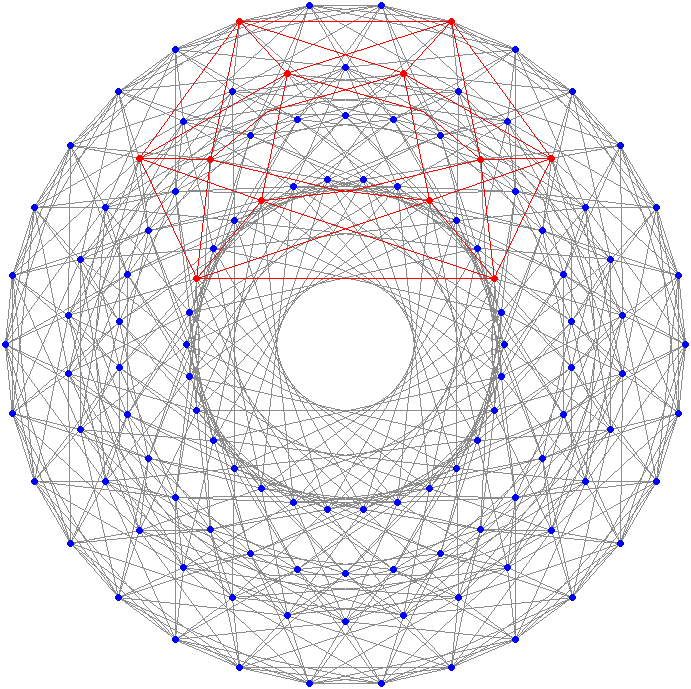
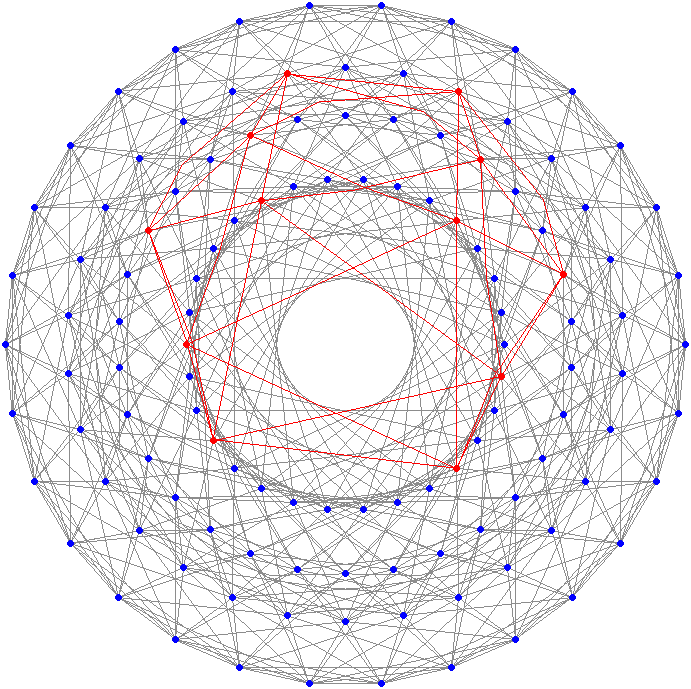
Note that each picture gives thirty through rotation, because the pictures are symmetric, flipping does not change the number. You may verify that each of the twelve vertices marked in red connects to five other vertices, but it is indeed a bit difficult to see the icosahedra.
Of course those edges can also be seen as edges of a great dodecahedron and in that case they are the cells of the great 120-cell.
The following pictures show the dodecahedra that can be found that make the grand 120-cell:
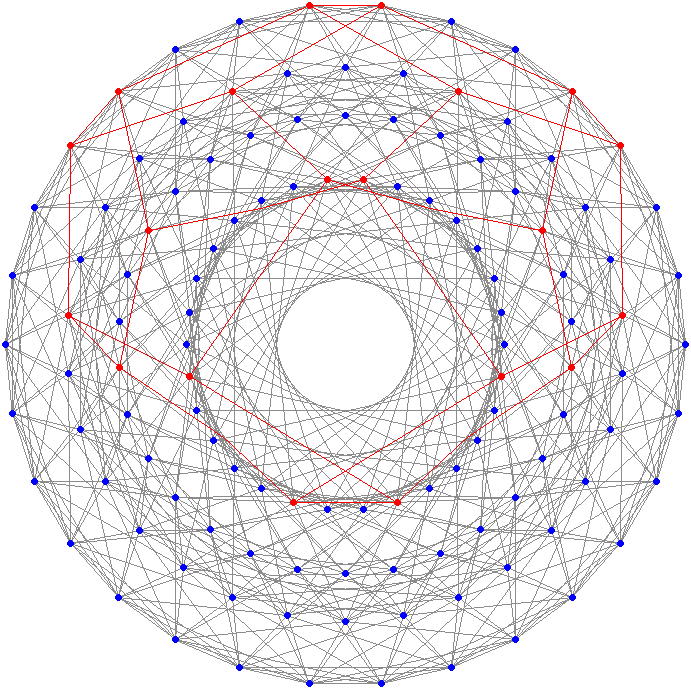
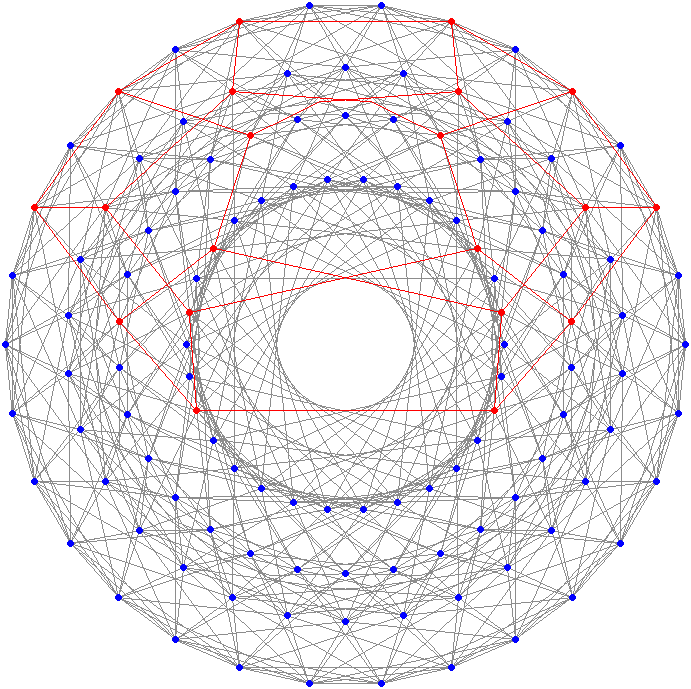
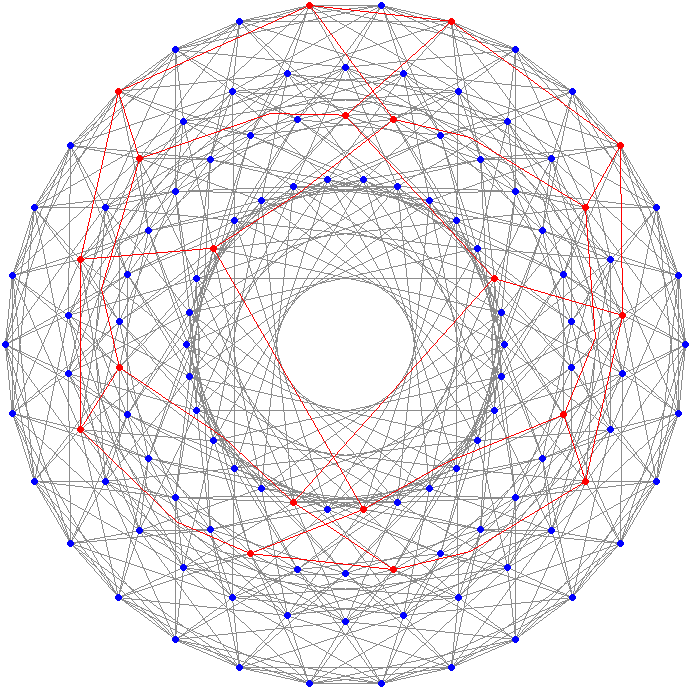
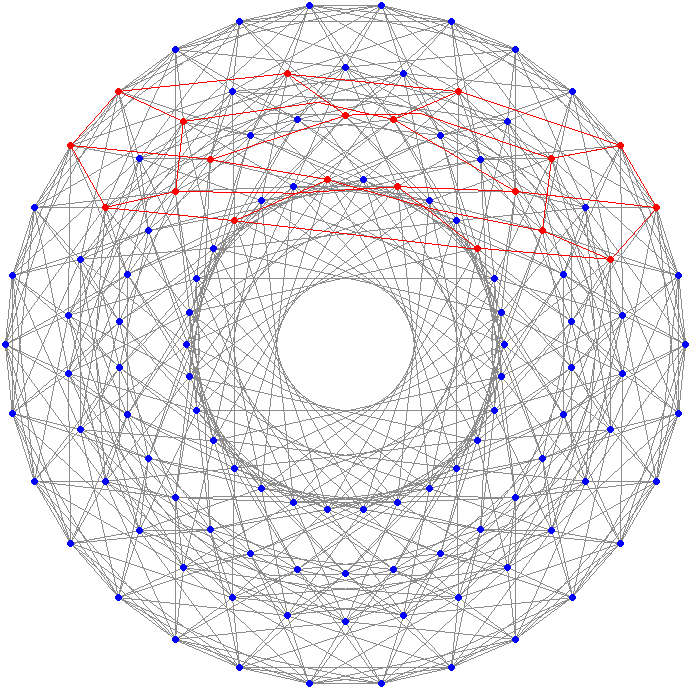
Again, a bit difficult to see, but you can see that each of the twenty vertices connects to three other vertices.
The decagons are found through the following pictures:
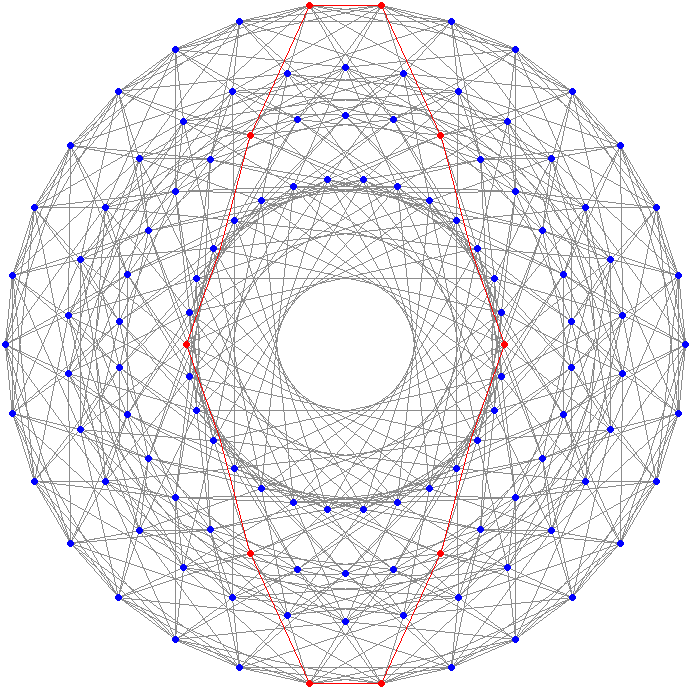
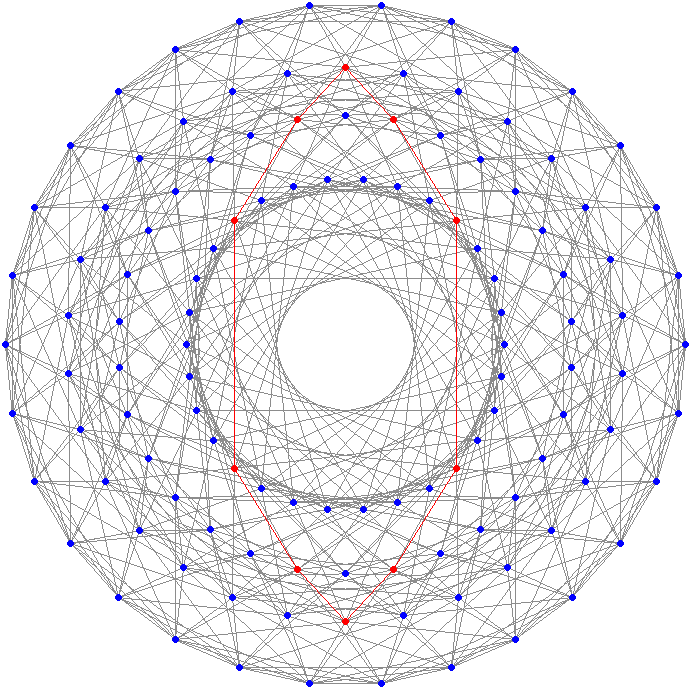
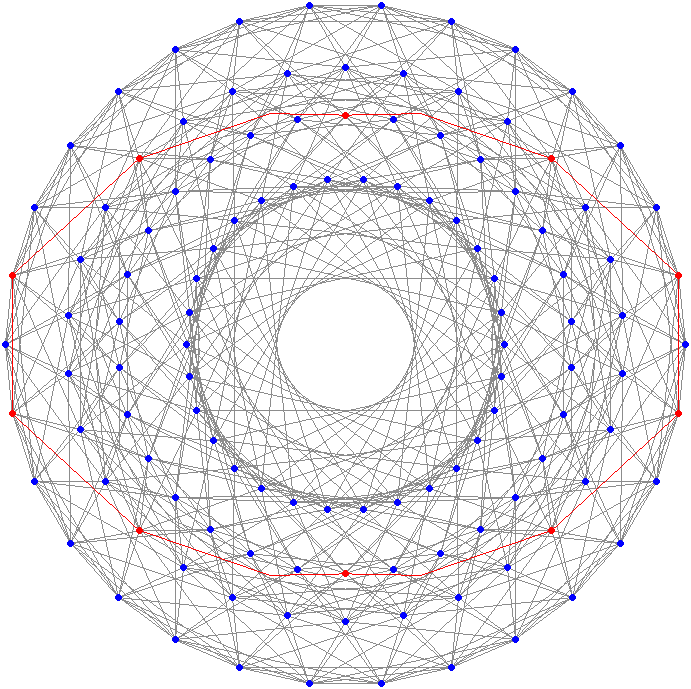
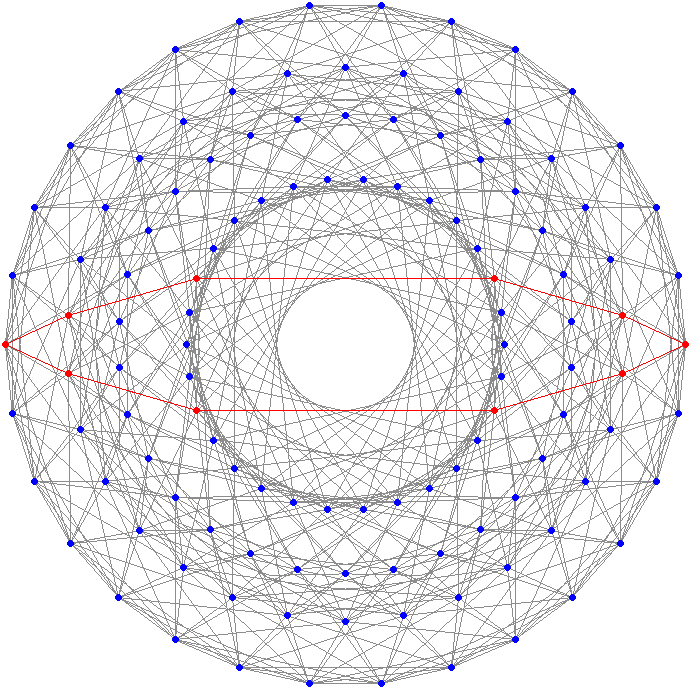
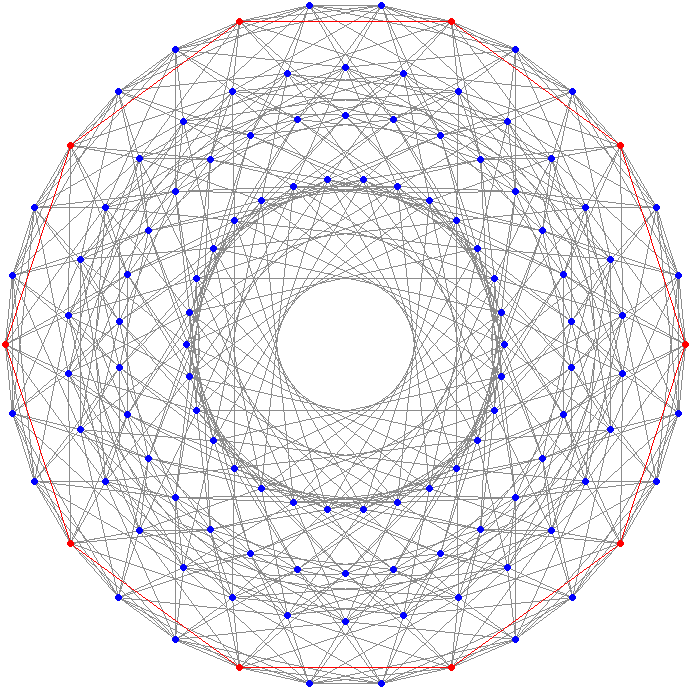
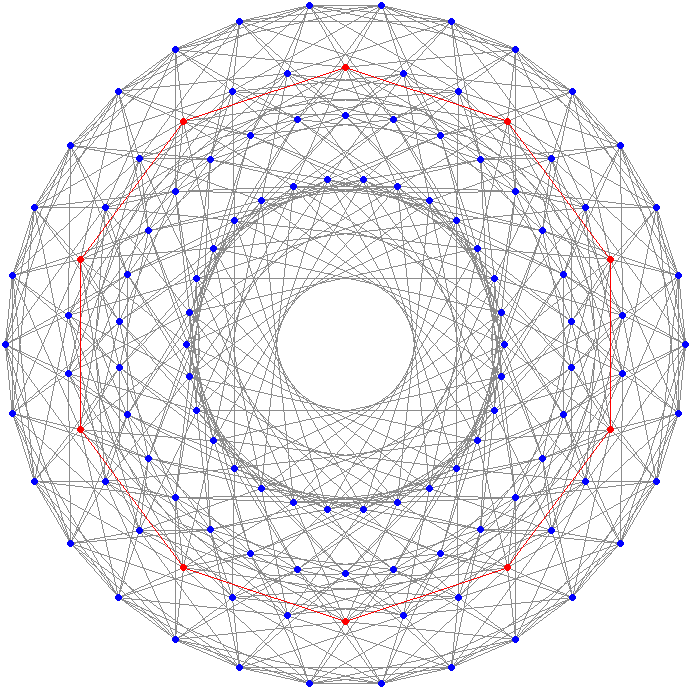
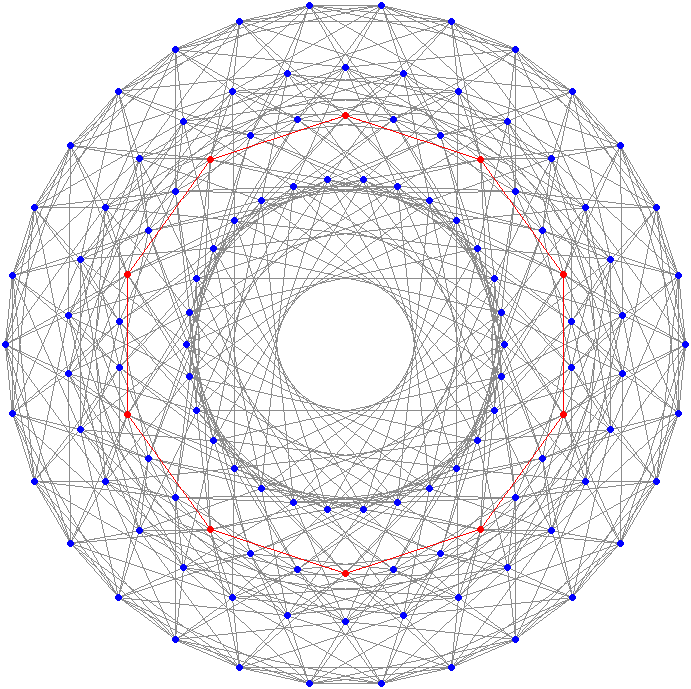
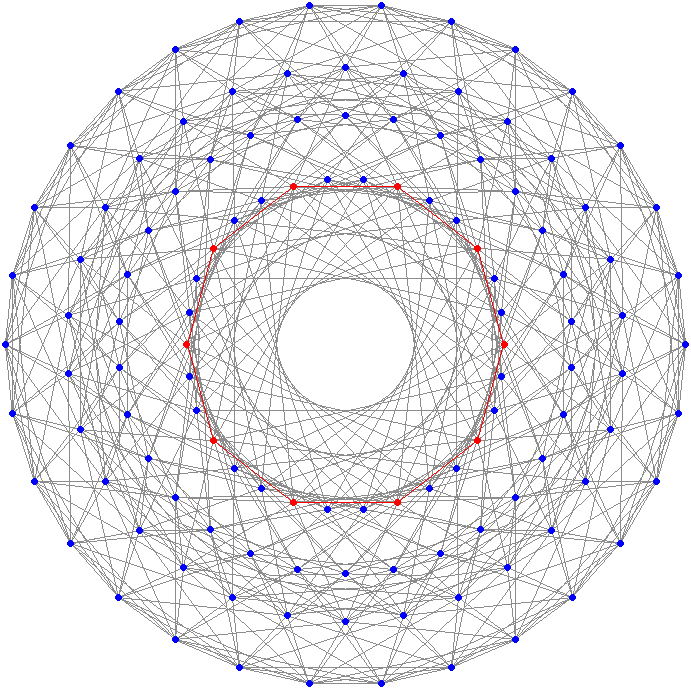
Rotations give fifteen for the first four pictures and only three for the last four.
Section 2 looks as follows:
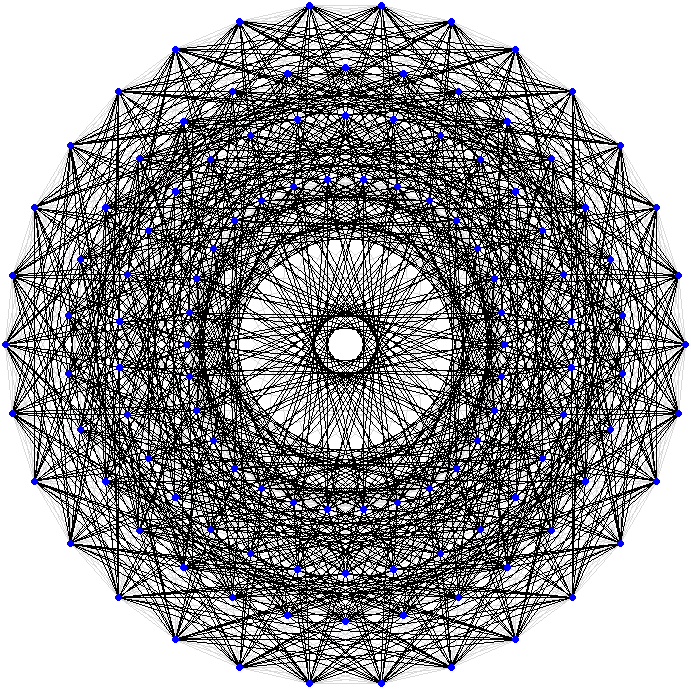
These pictures show the tetrahedra in this section:
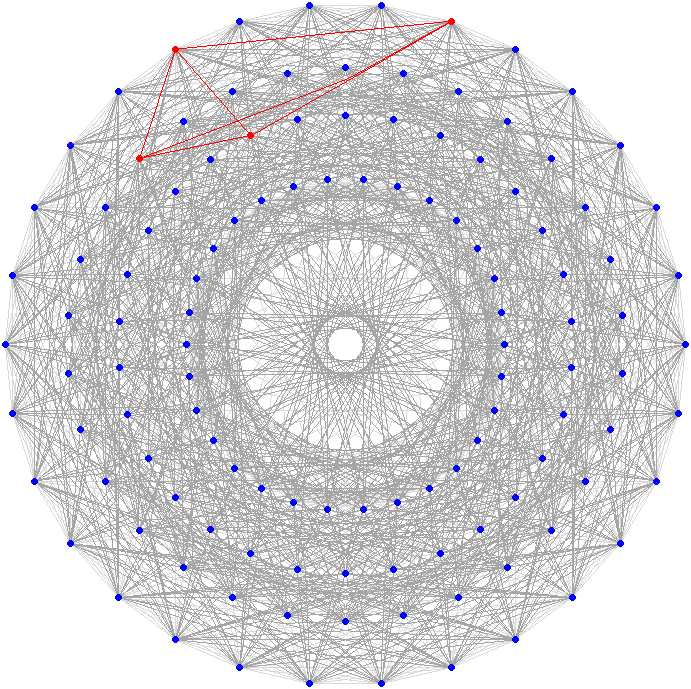
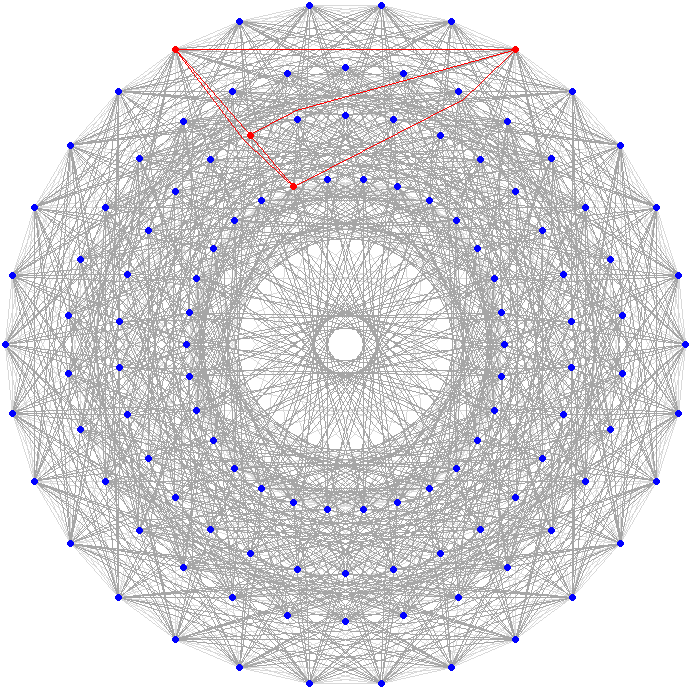
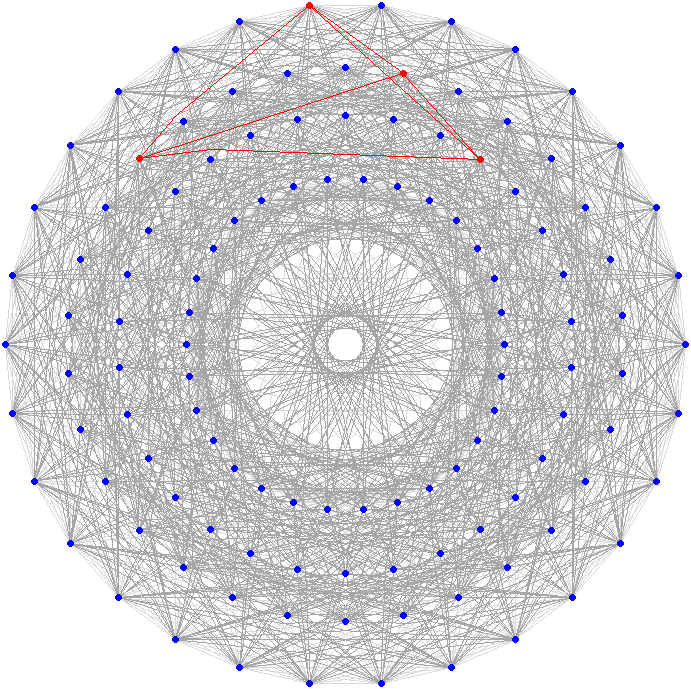
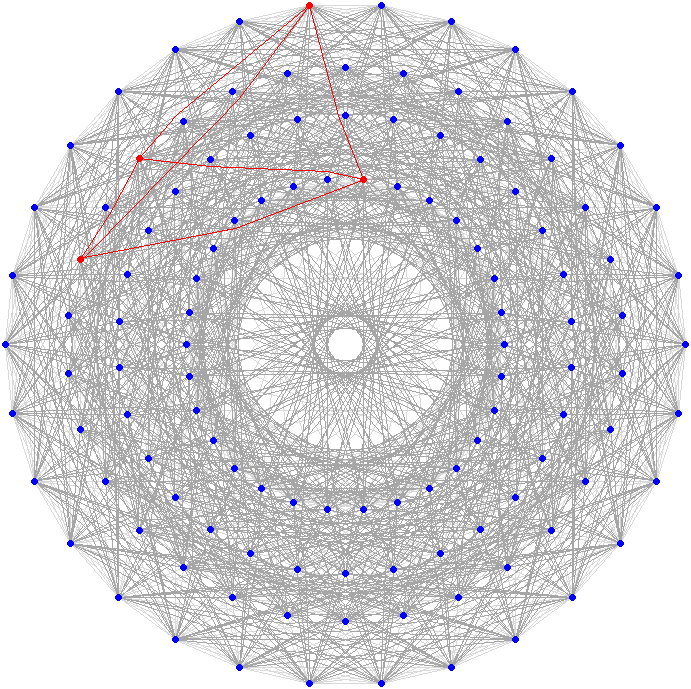
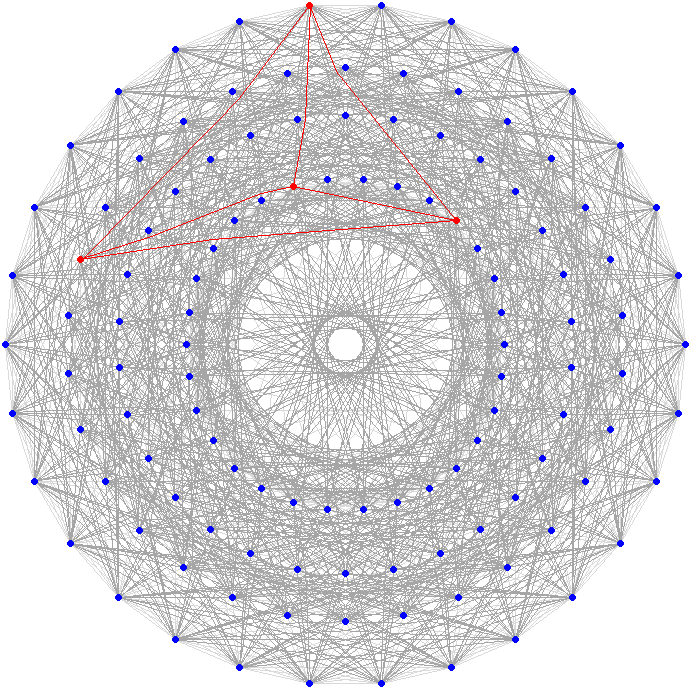
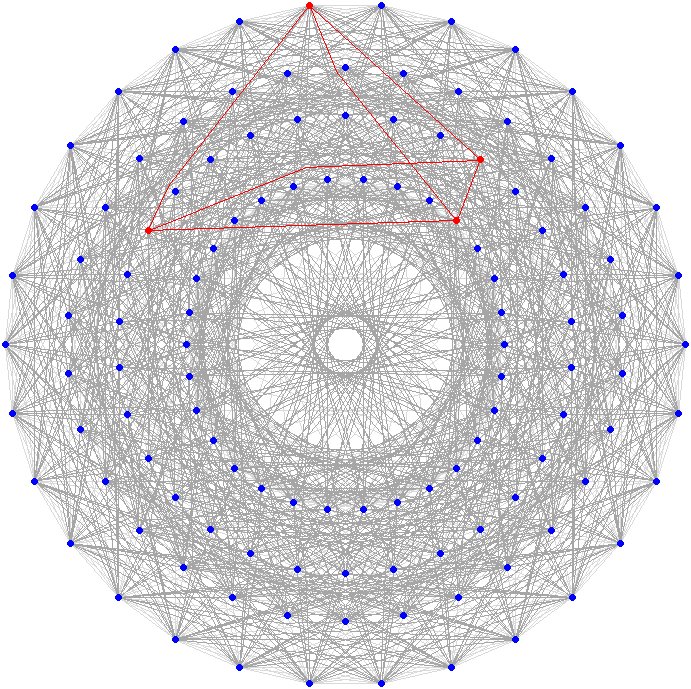
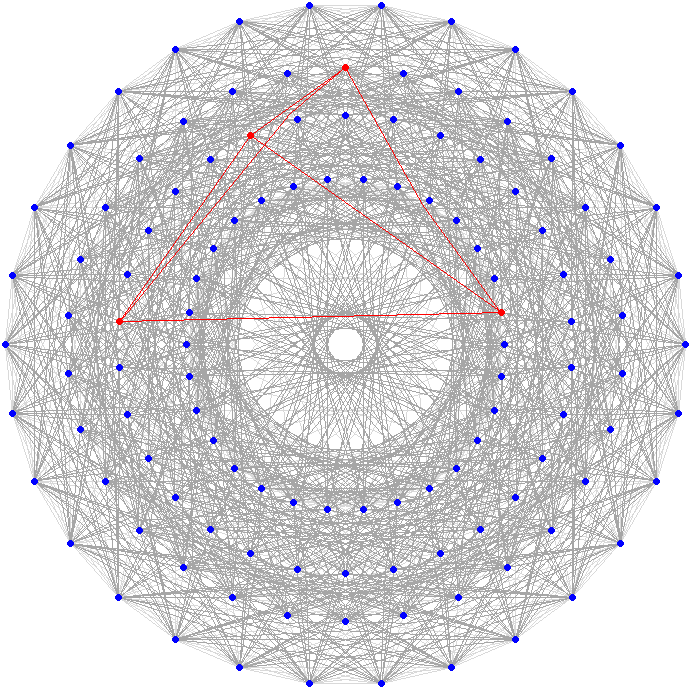
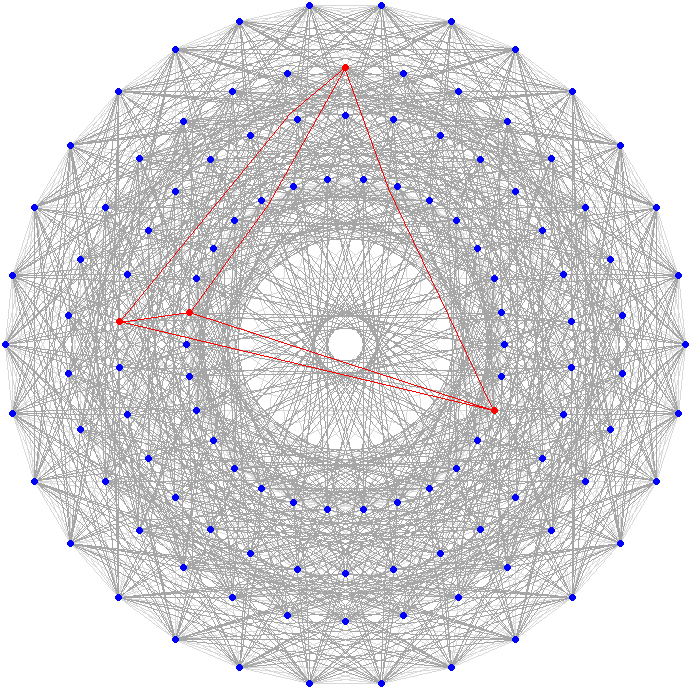
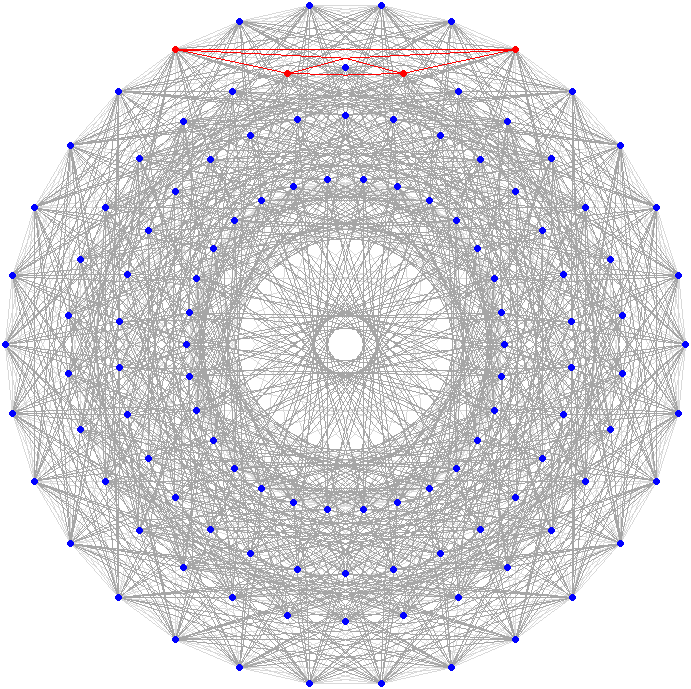
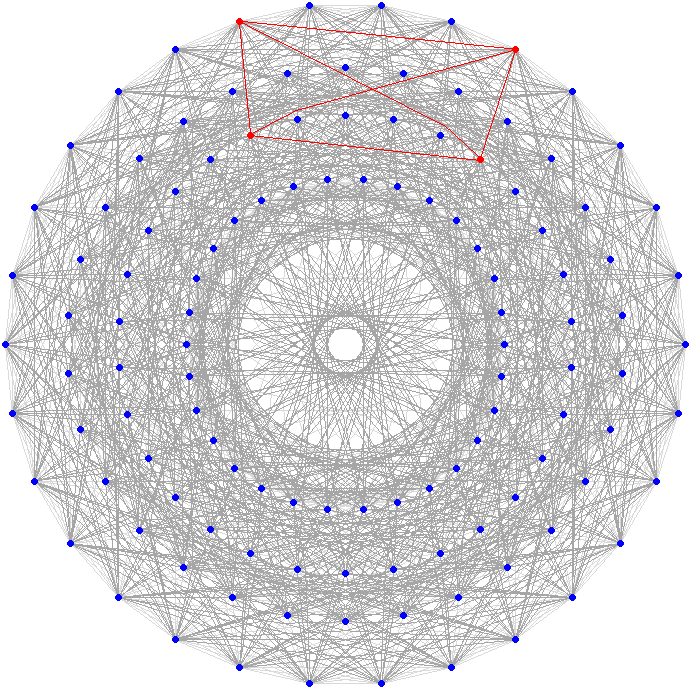
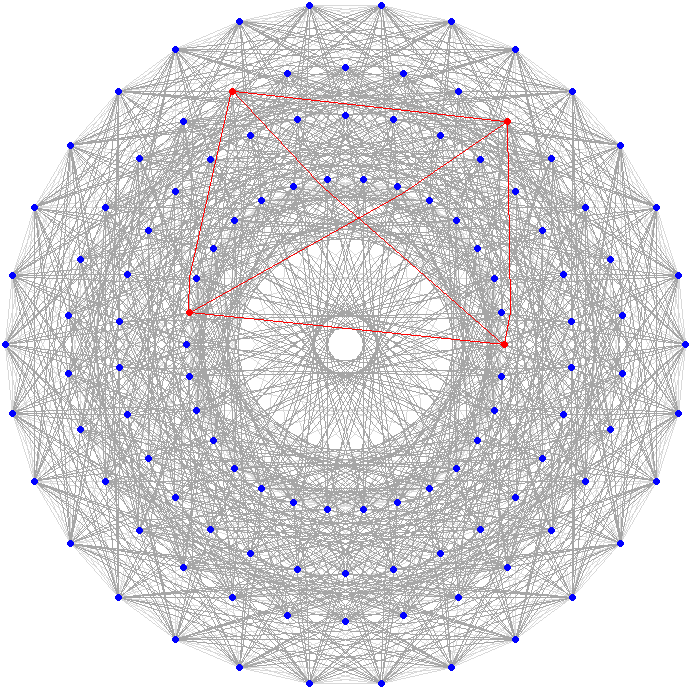
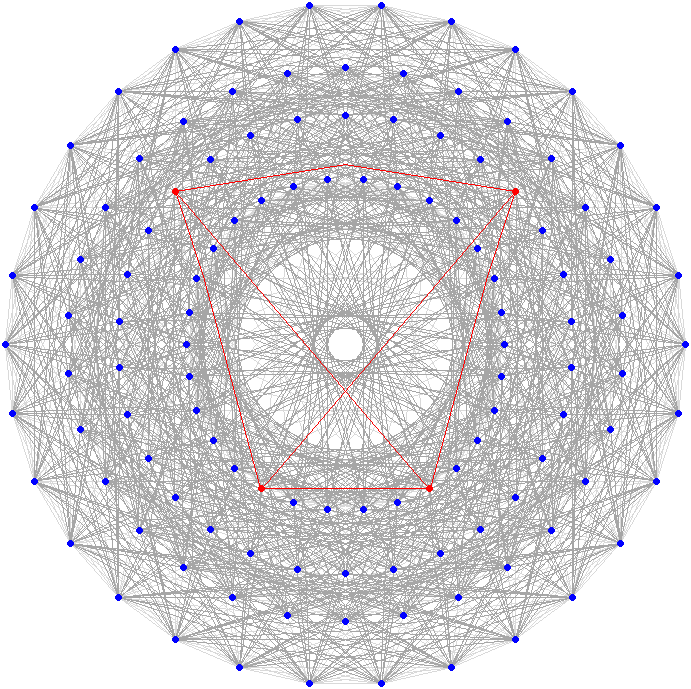
The first eight pictures give sixty each with rotation and flipping, the last four only thirty, only rotation here.
These two pictures show the 24-cells
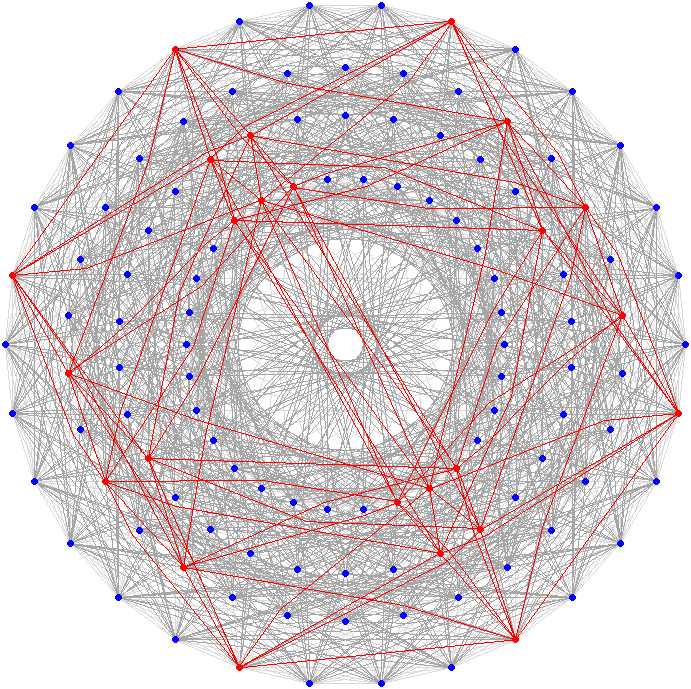
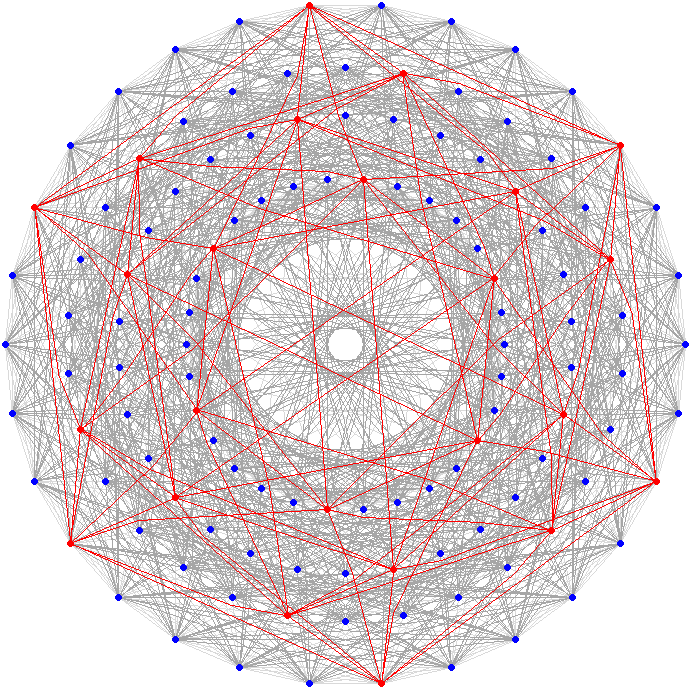
The first picture can be rotated to give fifteen different ones and the second picture can be rotated (only five different) and flipped for a total of ten different ones.
Here we show compounds of five 24-cells. I use five colours to display them:
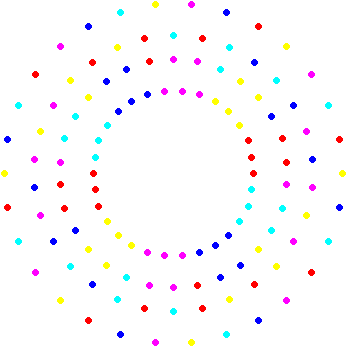
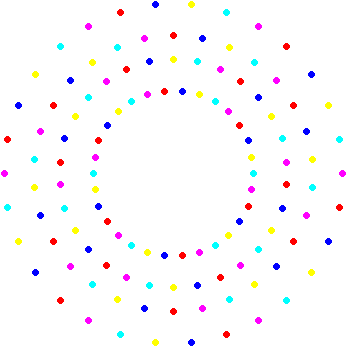
The first we get by rotating the first 24-cell above by 36, 72, 108 and 144 degrees. The second we get by doing the same with the second 24-cell. The following table gives the relation between the colours, the rotation and also the numbering of the 24-cells in the datafiles:
| deg | colour | left | right |
| 0 | blue | 2.1 | 1.1 |
| 36 | pink | 2.3 | 1.3 |
| 72 | yellow | 2.2 | 1.2 |
| 108 | red | 2.5 | 1.5 |
| 144 | turquoise | 2.4 | 1.4 |
Rotating the left through 60 degrees gives another one (with 24-cells 3.1 to 3.5) and through another 60 degrees fourth one (with 5.1 to 5.5). Flipping the right one through a vertical axis gives the fifth compound (with 4.1 to 4.5; but here 4.1 is the flip of 1.1, but the others are not flips of same numbered 1.x 24-cells, rather the rotation method above is followed in the data-files).
But it is possible to get yet another compound:
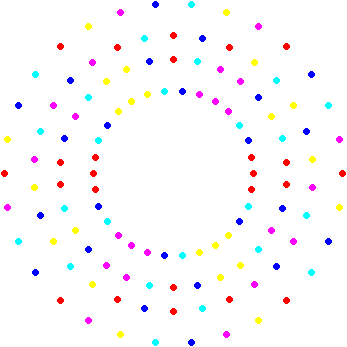
You get this when you start with the first 24-cell above, add to it the same rotated 60 degrees and again adding the same rotated another 60 degrees. Further you add the second 24-cell and the same flipped. The following table shows the colour coding (and the numbering in the data-files):
| deg | flip | colour | number |
| 0 | yellow | 2.1 | |
| 60 | pink | 3.1 | |
| 120 | red | 5.1 | |
| non-flipped | blue | 1.1 | |
| flipped | turquoise | 4.1 |
Of course this one can get rotated multiples of 36 degrees giving in total five new compounds. These compounds can not be transformed to the other compounds by the rotation group, but for the rotation group the other compounds are similar.
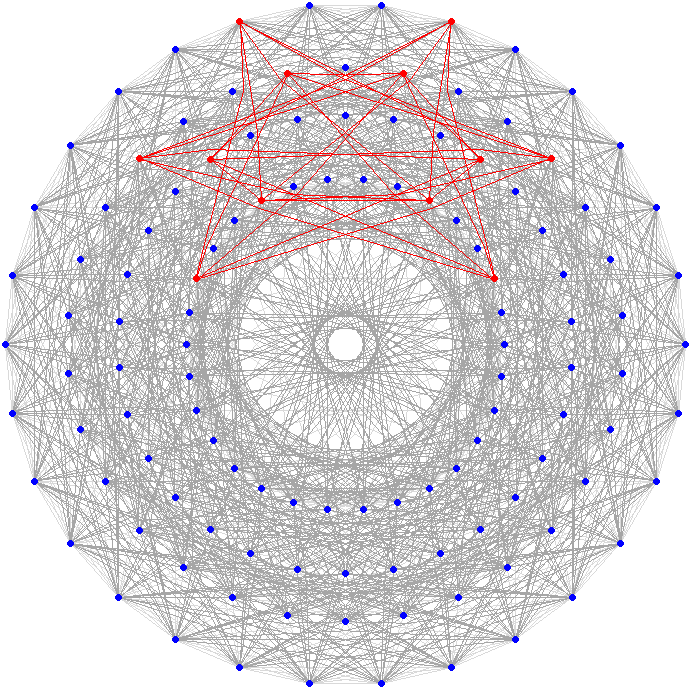
These pictures show the icosahedra and great dodecahedra in this section:
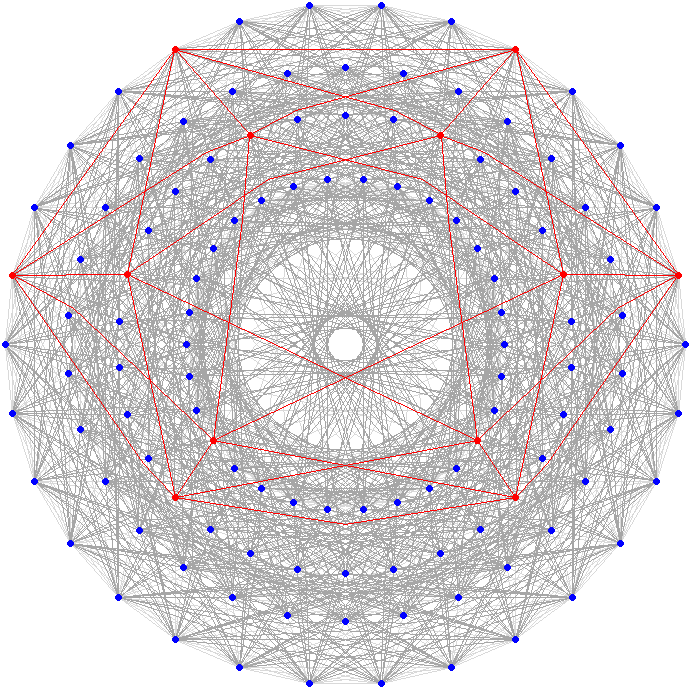
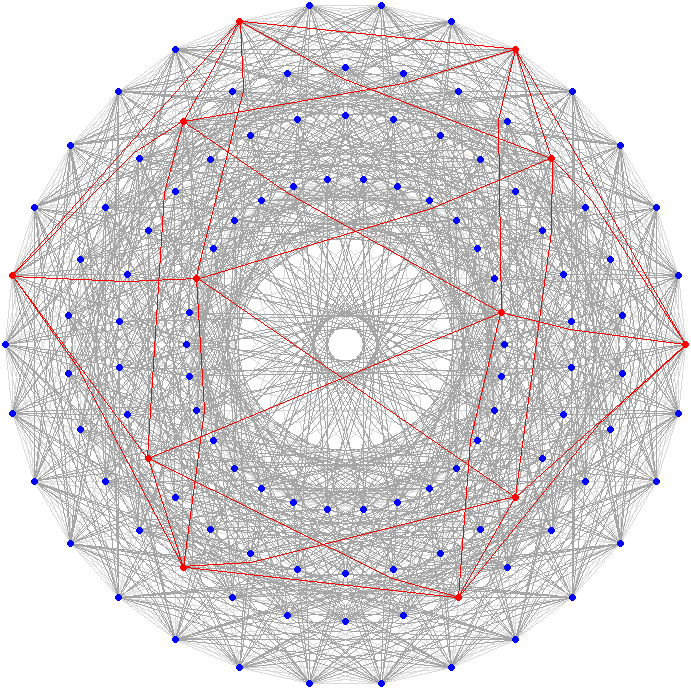
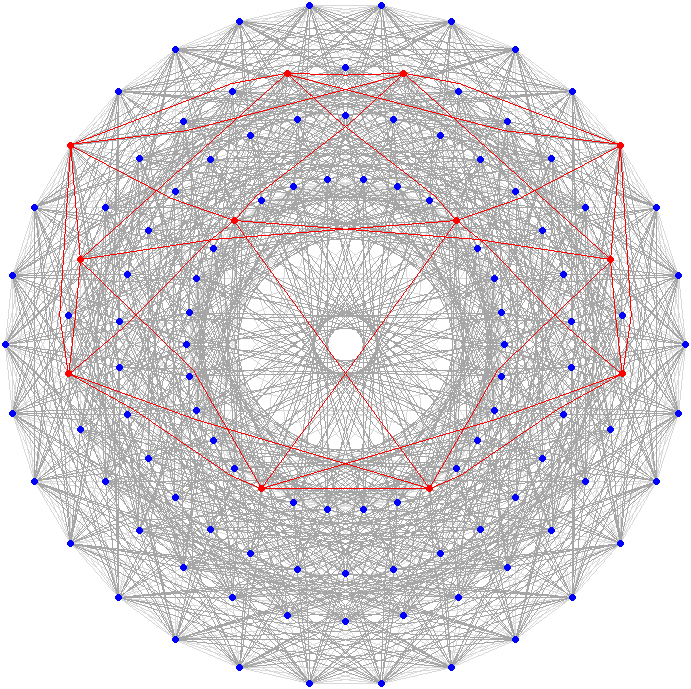
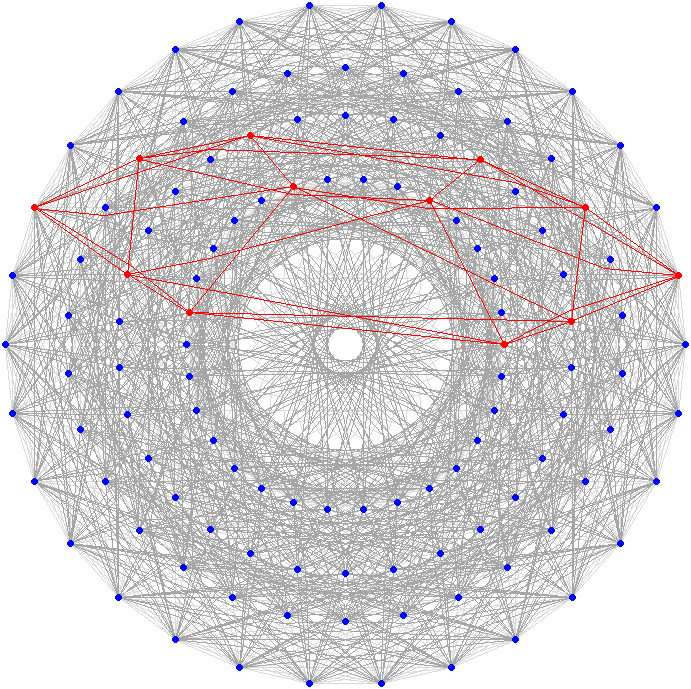
Through rotation each picture represents thirty of both.
Next the great icosahedra and small stellated dodecahedra:
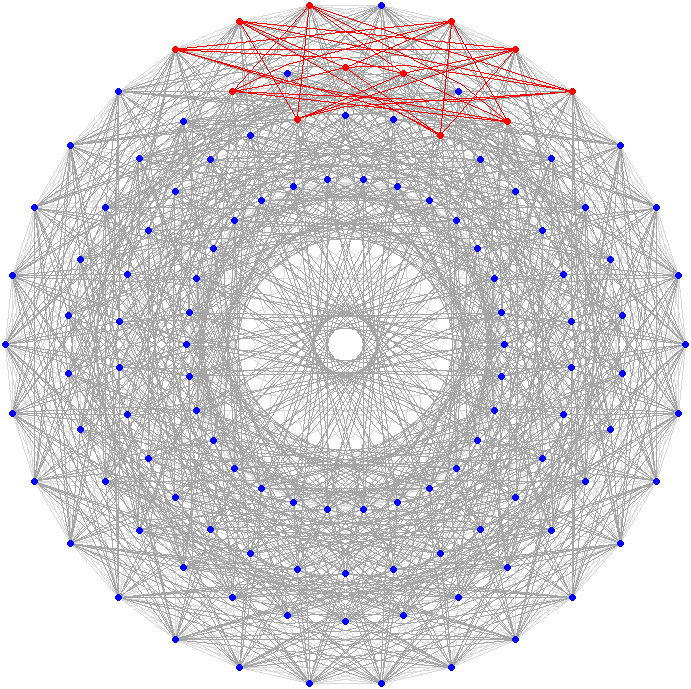
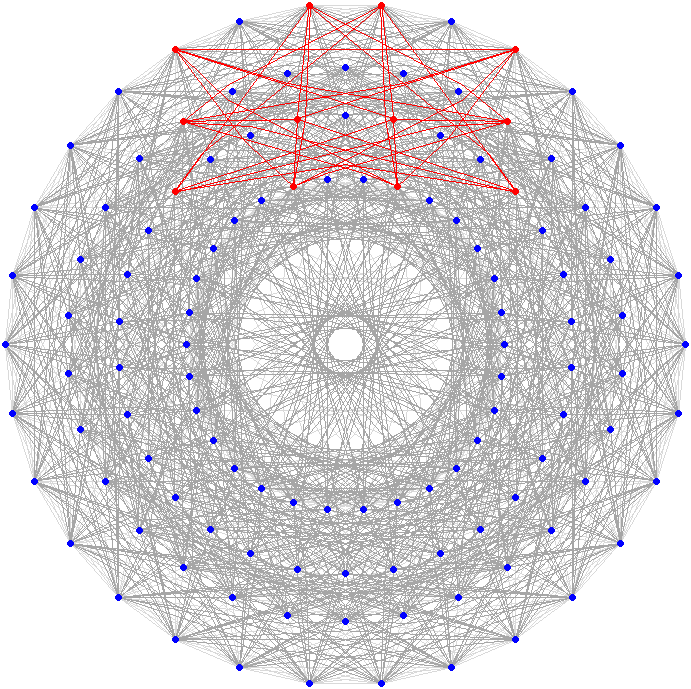
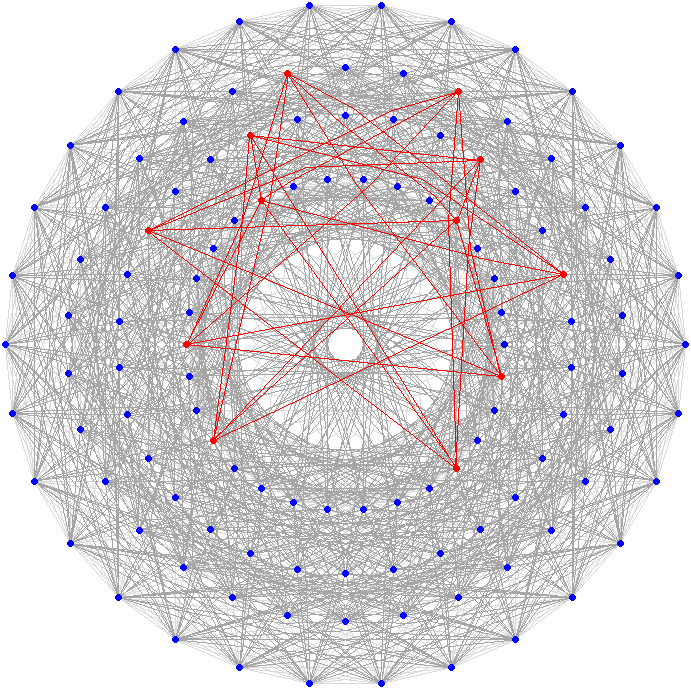
Here again thirty from each picture through rotation.
Finally the hexagons:
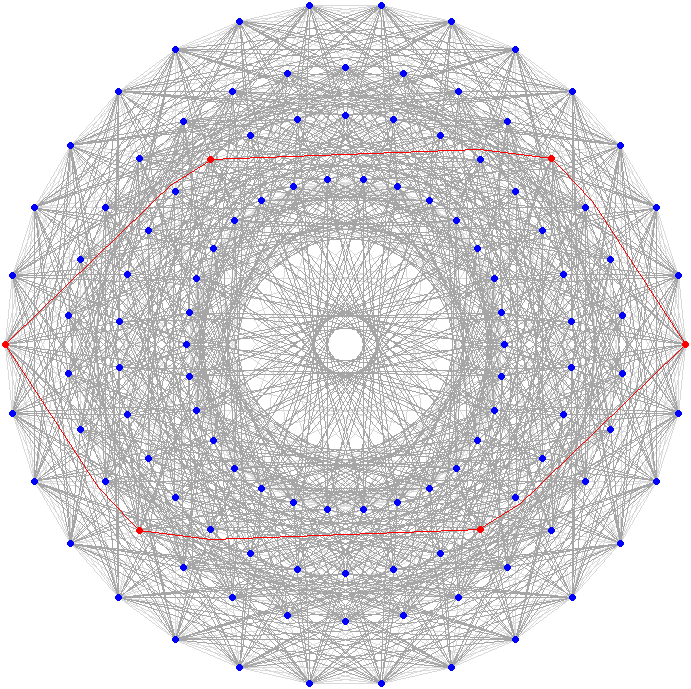
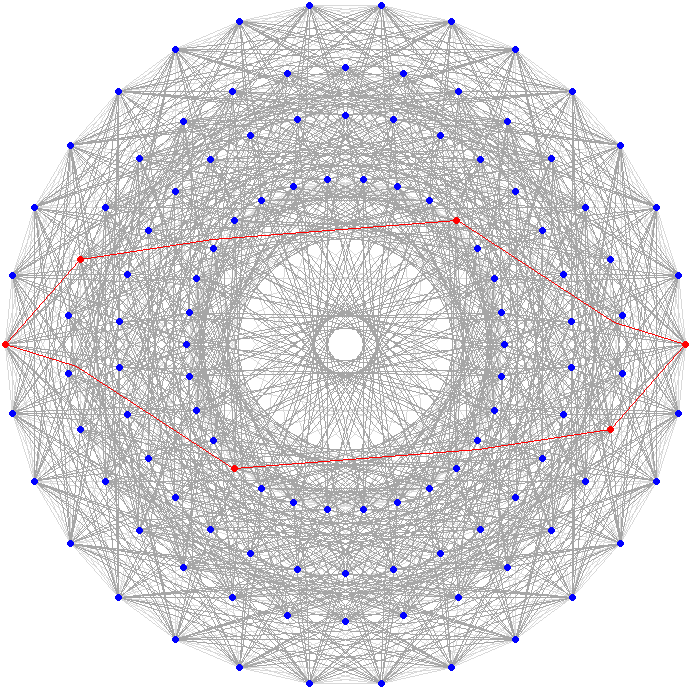
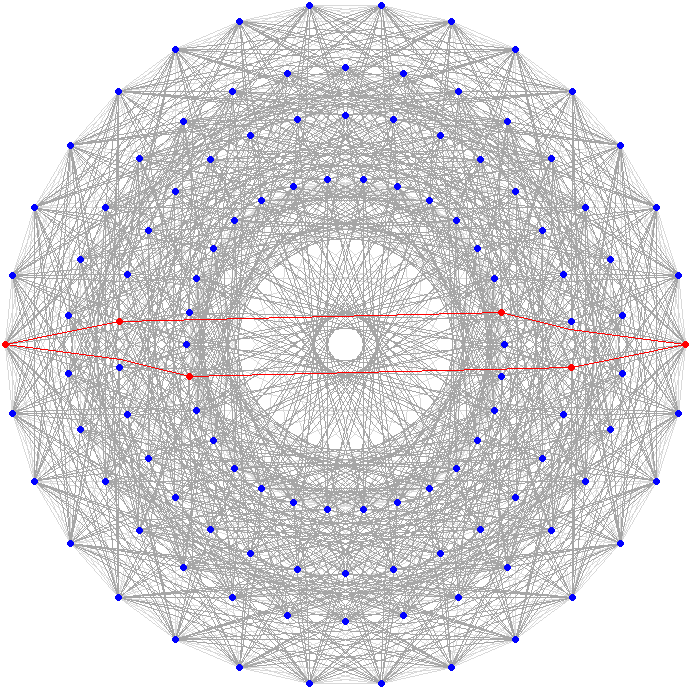
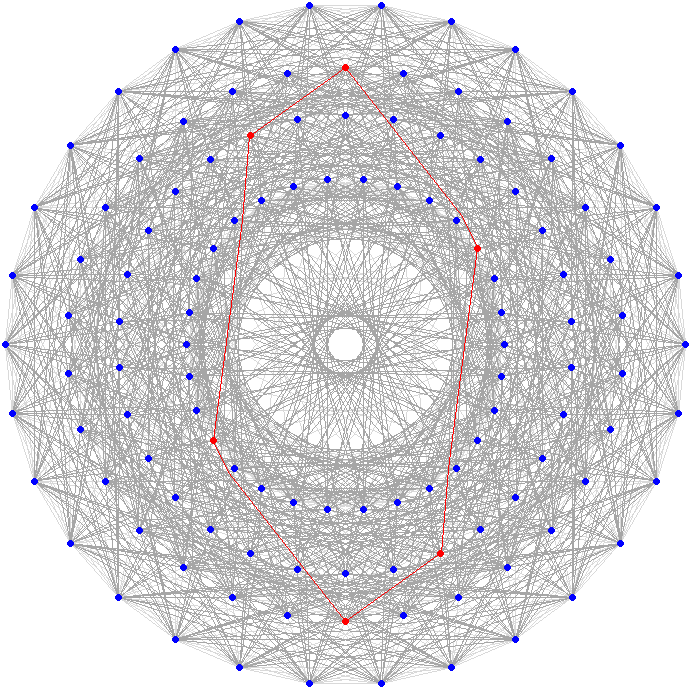
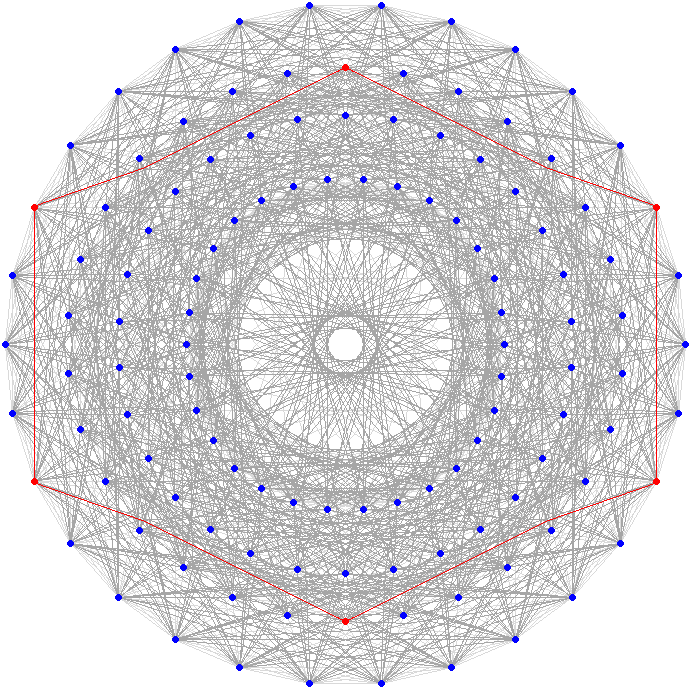
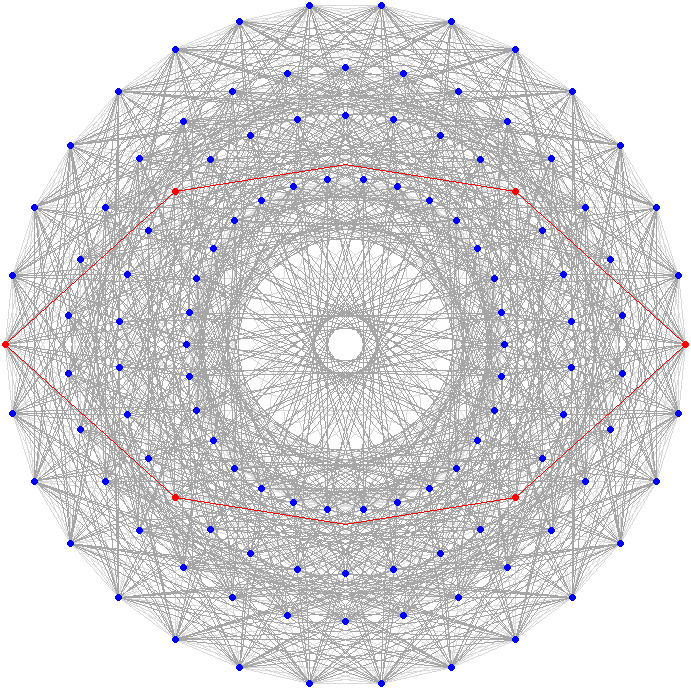
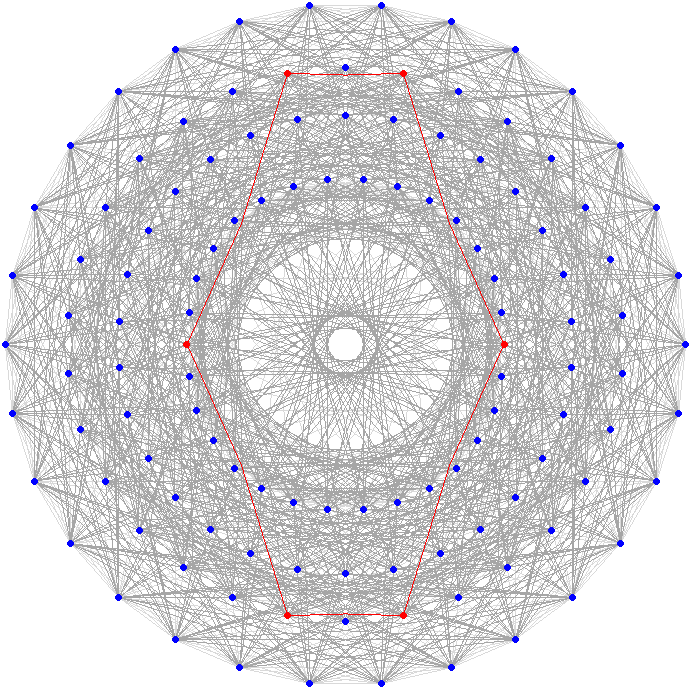
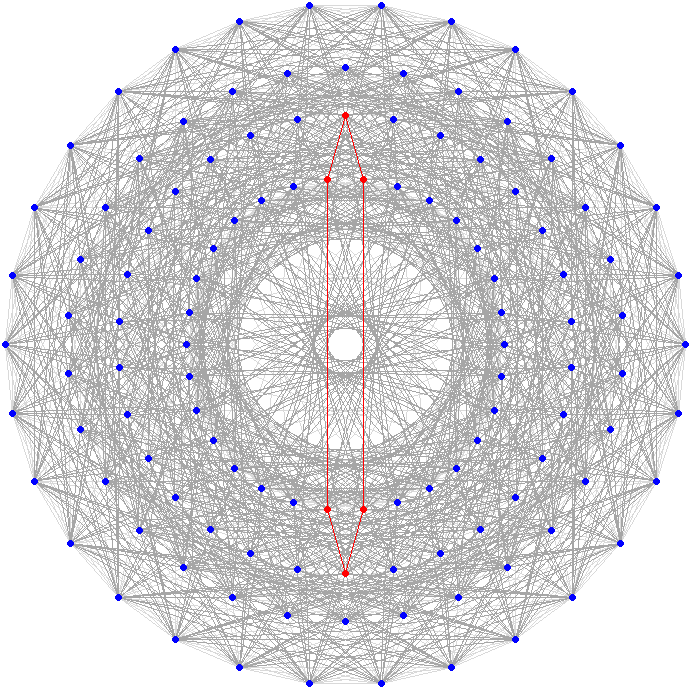
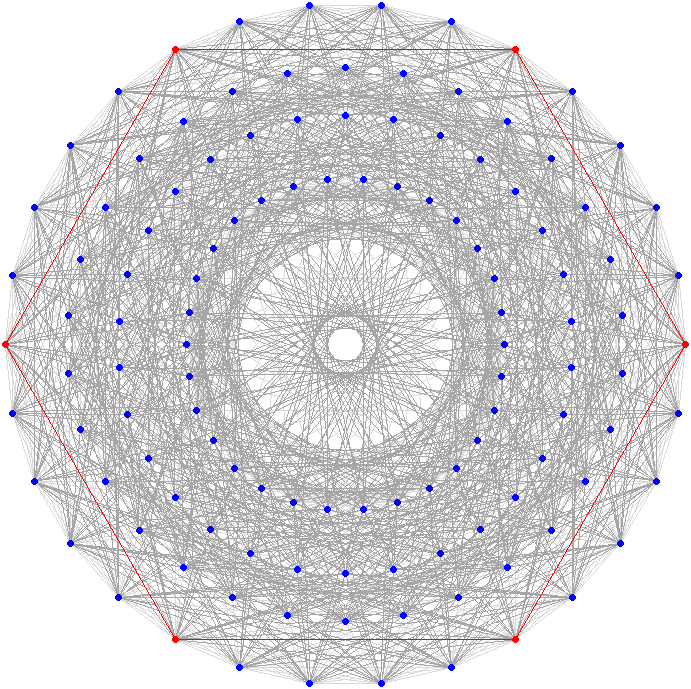
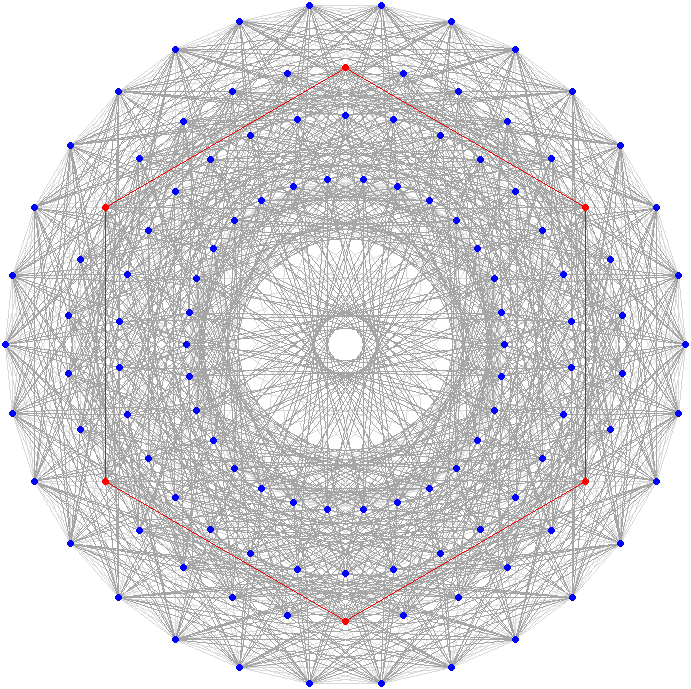
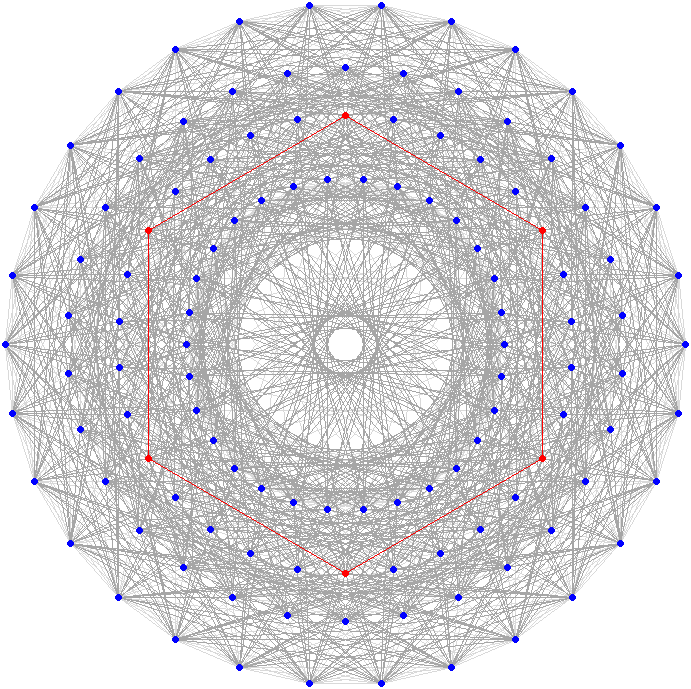
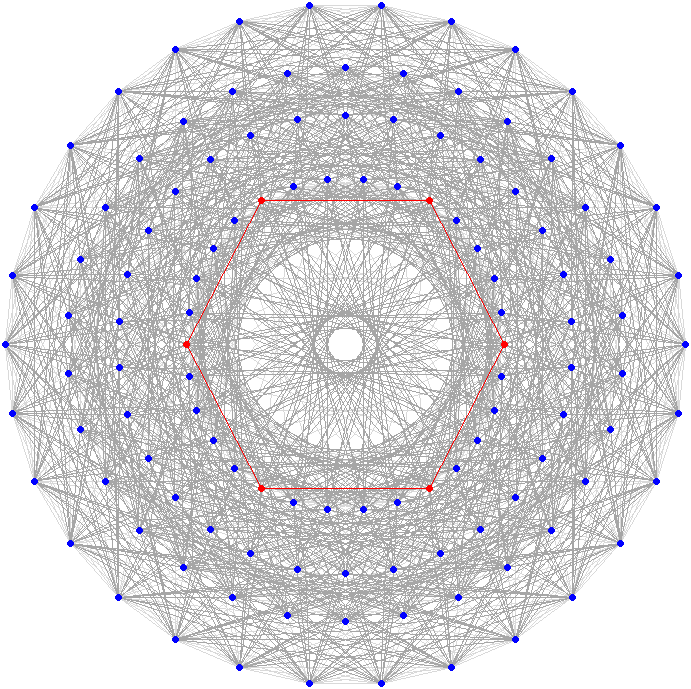
And here the first four represent thirty each (rotation gives fifteen, flipping doubles that), the second four represent only fifteen (no flipping because of symmetry) and the last four each only five (there is much more symmetry).
The tesseracts you will find as constituents of the 24-cells, and also the compounds from tesseracts are better explained later in section 4.
SECTION 3 STILL TO BE SUPPLIED
SECTION 4 HEADER STILL TO BE SUPPLIED
16-cells in this section are not given individually, they can be found as constituents of the 24-cells in section 2. However, an attempt is made to give more insight in the compounds that can be found. Initially when you start with a compound of 24-cells you can replace each 24-cell by the three 16-cells that form a compound of it and the result is a compound of 16-cells. This obviously gives ten different compounds; I will not show them. But more compounds can be found, and as each compound is also cell-regular, the reciprocal forms a compound of tesseracts, where each vertex is covered twice.
The first way to get new compounds is when you start with a left-handed and a right-handed compound. Below the pictures show on the left the second left-handed compound of 24-cells from above and the right-handed compound. The have the blue 24-cell in common, so that one does not play a role anymore. Of the remaining 96 vertices I have blacked out two thirds (64 vertices) with 32 vertices remaining in colour. In both pictures the coloured vertices form a 16-cell (although the edges are not shown, and you should ignore the blue vertices), those are given on the right:
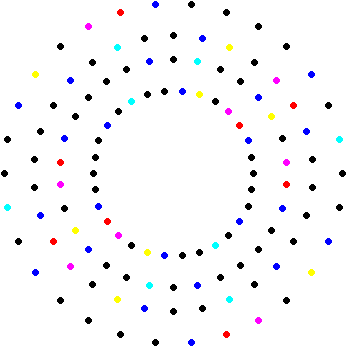
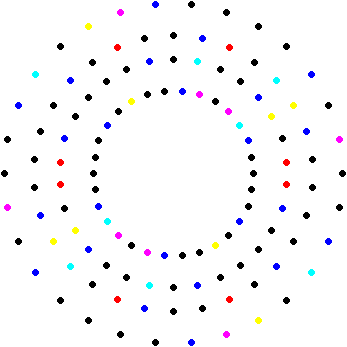
Rotating the black mask by 60 or 120 degrees gives similar pictures. So when we start with a compound of 16-cells based on the top-left picture, we can replace the 16-cells from the top-right picture by those from the bottom-right picture, giving a new compound. We can do that with each set based on the mask as is, with the mask rotated by 60 degrees and with the mask rotated by 120 degrees. This way we get three new compounds. Also we can do that twice (with different masks) again giving three new compounds. Finally when we do it three times we get the right-handed compound based on the bottem-left picture. We can do similar with each pair of a left-handed and a right-handed compound, so for each of the 25 pairs we get six new compounds, for a total of 150 of two new types (the two being distinguished by handed-ness, one change gives one type, two changes the other). But this is not all.
We can also start with three compounds of 24-cells of the same handed-ness, replace each 24-cell by its compound of three 16-cells and select one from each of those 45 triples. If we do the selection with care we end with a compound of fifteen 16-cells. To show the process, I give the following picture (and here you should not ignore the colour blue). I start with the two left-handed compounds of 24-cells above, and add as a third the compound obtained by the second by mirroring through the vertical axis. These three are shown on the left. I apply (like above) masks on one third of the vertices in each compound to get for each a set of five 16-cells as given on the right (in different colours). You may note that the coloured vertices are disjoint within the three pictures on the right, so they form a new compound:
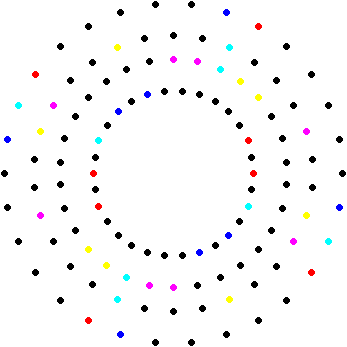
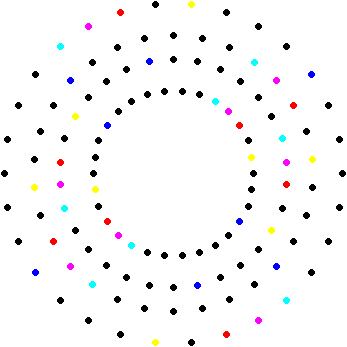
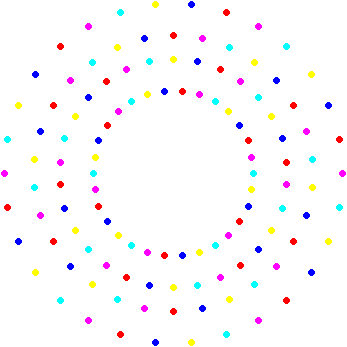
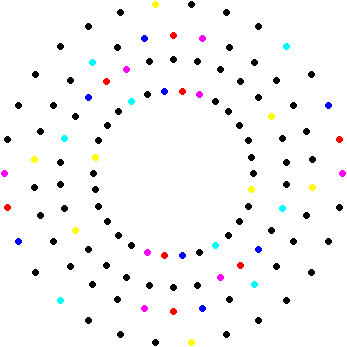
When we rotate the mask by 36, 72, 108 or 144 we get in a similar way new compounds again, so we are now up at five new compounds for this triple. There is however a sixth way, see below:
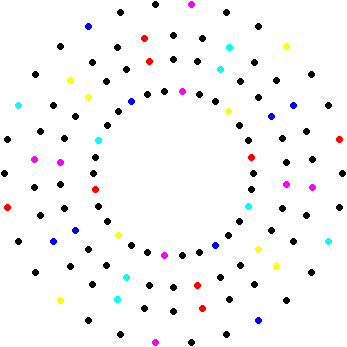
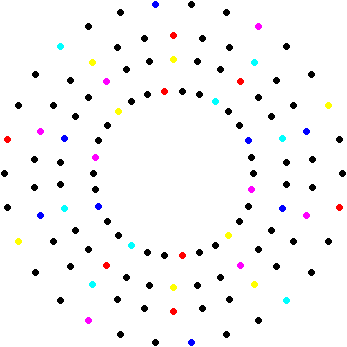
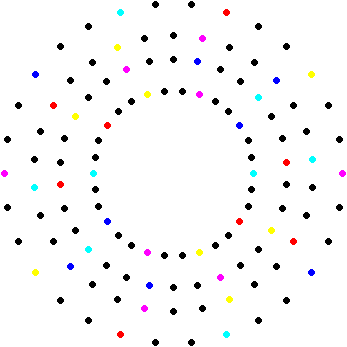
Similar things can be done with each triple of same-handed compounds. As there are ten such triples for each handedness, we get sixty new compounds for each handedness, for a total of 120. Together with the other compounds mentioned, this gives all 280 compounds of 16-cells of six different types, and also for the compounds of tesseracts. (But of course you have to look at the masks to apply in other combinations.)
MORE STILL COMING
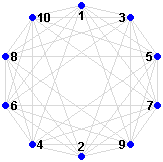
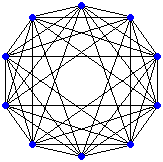
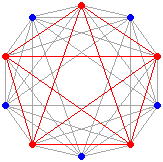
Section 1 has the following edges:
The hypercells (5-cells) are shown with the following pictures:
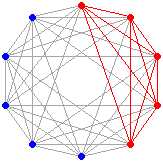
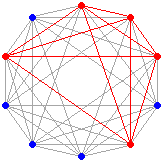
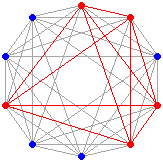
The first three pictures give each ten 5-cells through rotation, the last one gives only two.
To find the cells you just omit one vertex (and the associated edges) from a 5-cell.
To find the 16-cells in the general picture, you omit two opposite vertices from the original and the associated edges.
Larger dimensional polytopes of this family are just as easily described.
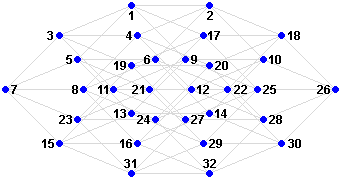
Like with the cube, the pictures have been elongated horizontally.
Section 1 has the following edges:
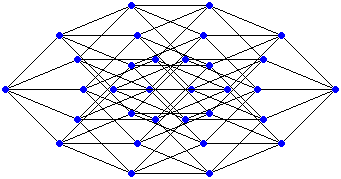
Note that the line connecting four vertices in the center actually consists of two edges, connecting alternating vertices.
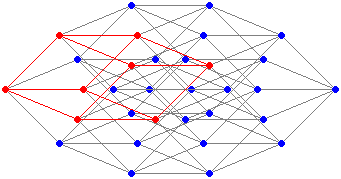
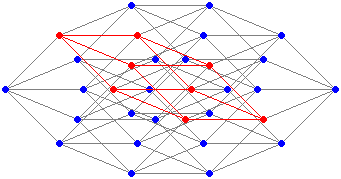
Finding the hypercells (tesseracts) is not very easy, but the following three pictures show them:
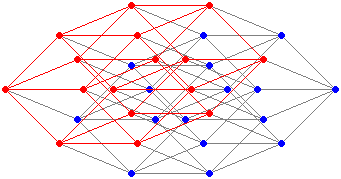
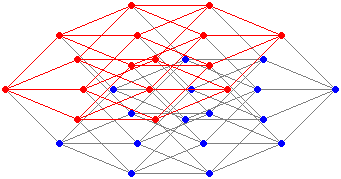
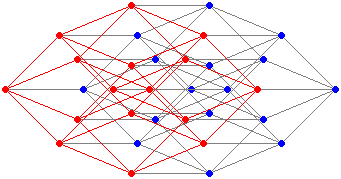
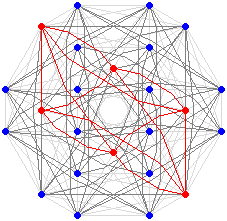
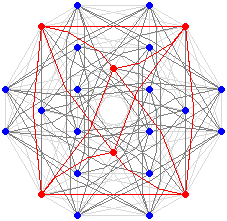
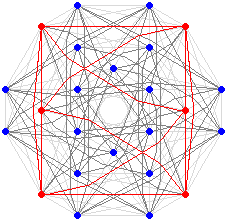
The first two pictures give four when you flip vertically or horizontally, the third gives only two, for a total of ten. But even this is not clear, so we need the cubes. We need twelve pictures to show them all:
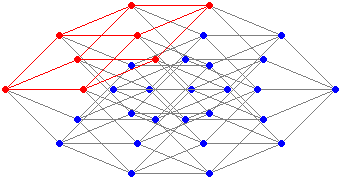
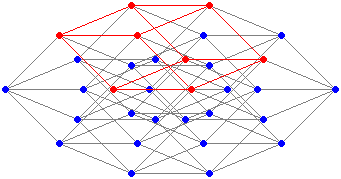
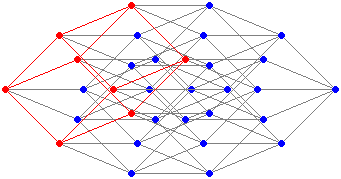
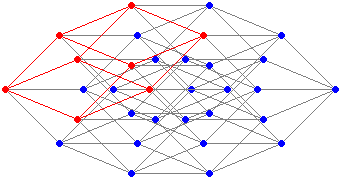
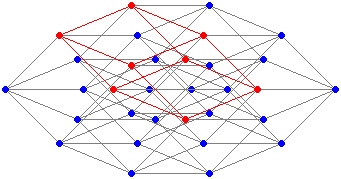
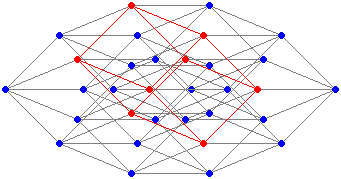
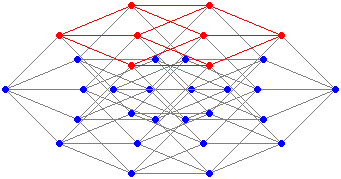
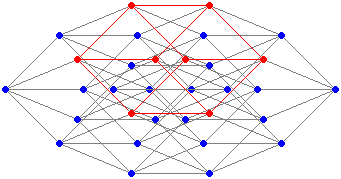
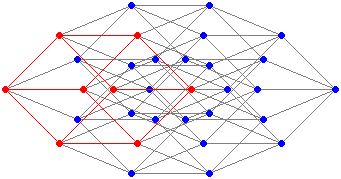
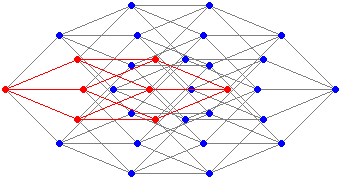
With flipping the first eight give four cubes, the remaining four give only two, for a total of forty.
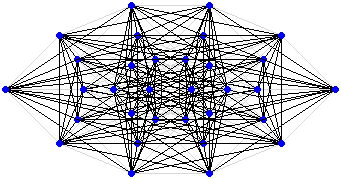
Section 2 is barely inunderstandable, even when some of the edges have been distorded:
However, there is a total split here, as shown in the following picture:
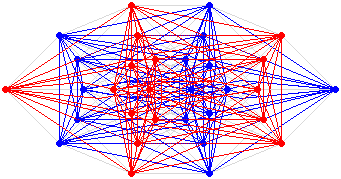
The red and blue parts have no connecting edges, and they are in fact semi-regular 5D polytopes. Interestingly, due to the lengthening the split appears quite natural. The hypercells of each are sixteen 5-cells and ten 16-cells.
The following pictures show the 5-cells (in the red semi-regular polytope):
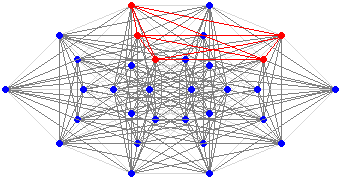
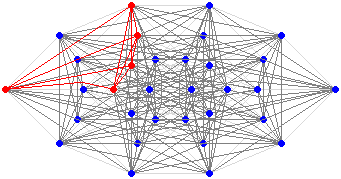
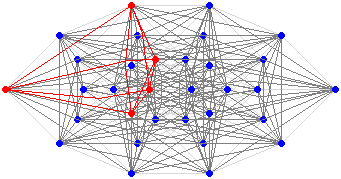
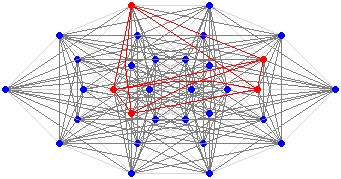
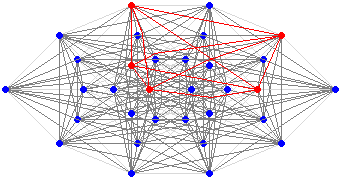
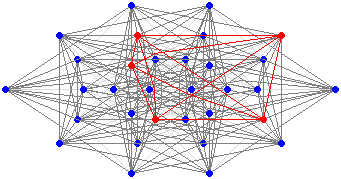
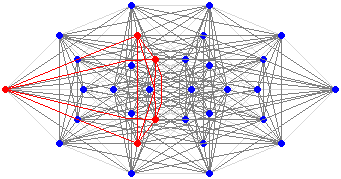
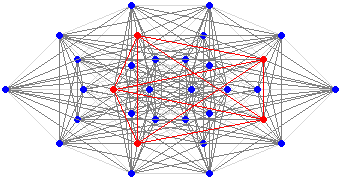
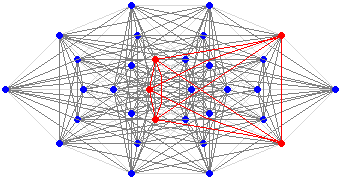
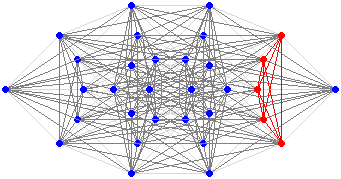
The first six give (through flipping) two each, the last four give only one.
The 16-cells (in the red polytope) are given by the following pictures:
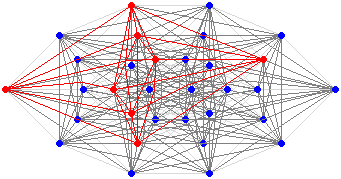
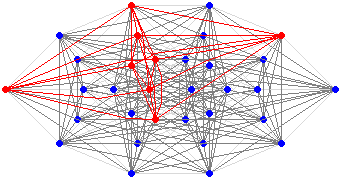
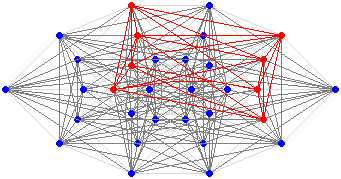
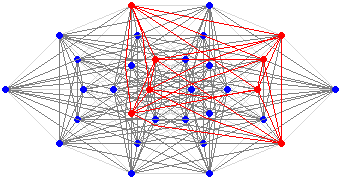
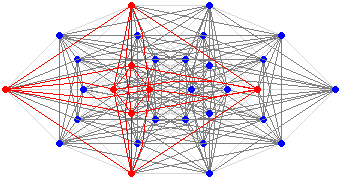
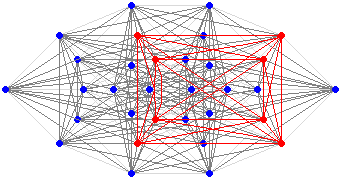
Again, the first four give two by flipping, the last two only one.
The semi-regularity here is similar to that with 3D archimedean semi-regular polyhedra. Each 5-cell connects at each bounding cell with a 16-cell, and each 16-cell connects at each bounding cell with either a 5-cell or a 16-cell in an alternating fashion.
To see more about this, we start with a triangle and the three tetrahedra that share it:
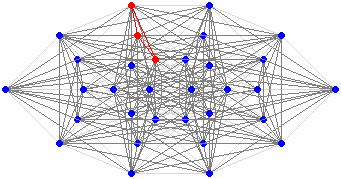
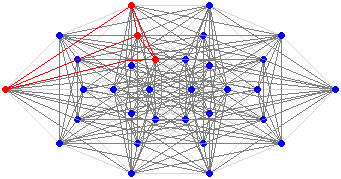
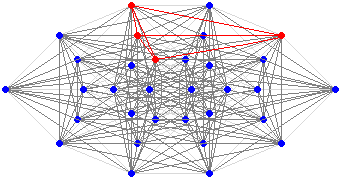
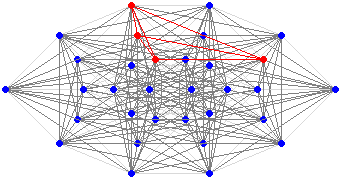
The first tetrahedron is common to two 16-cells and the second and third are common to a 16-cell and a 5-cell (the tetrahedra are given in turquoise):
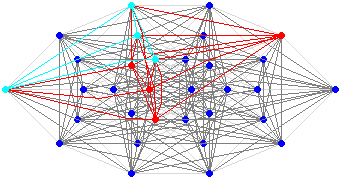
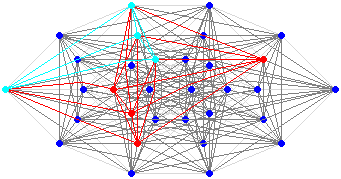
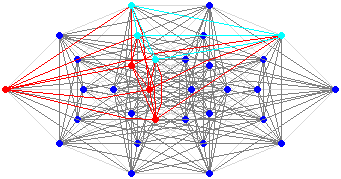
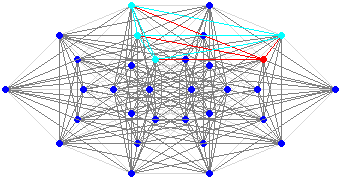
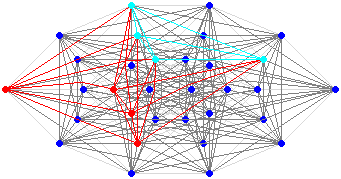
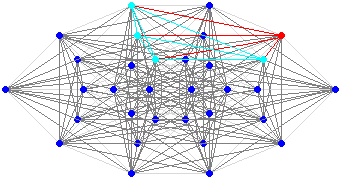
Note that there are actually only one 5-cell and two 16-cells involved.
Section 3 is totally inunderstandable, even when some of the edges have been distorded:
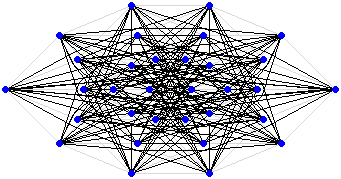
All the edges are in the picture, but there are no additional features here.
Section 4 is a bit better because there are fewer edges:
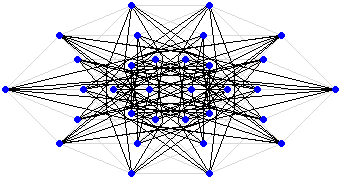
Here there is a total split:
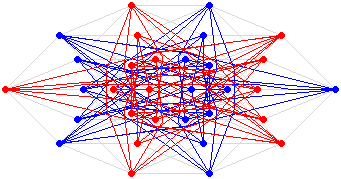
A bit clearer perhaps, but still not very clear. Also here there are no additional features. Also due to the cramped spece in the center, there are edges that, at least partly, come together.